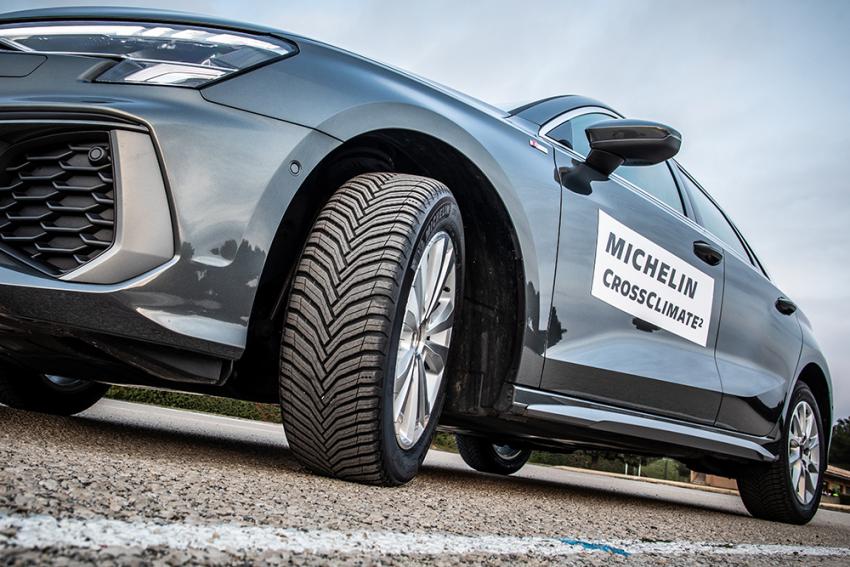
The four-season tire market keeps scoring positive numbers, prompting tire manufacturers to increase investments in this segment. Michelin knows this well and recently presented the second generation of its CrossClimate. Released in 2015, the French group's all-season tire, in its first version, was to be considered more of a summer tire capable of dealing with cold, snow and icy conditions. A result linked to particular technical choices, starting with its tread design. Since its launch, around 23 million units have been sold in Italy and Europe, including the CrossClimate+ version for SUVs and vans.
 The new Michelin CrossClimate 2 is available on the market in 105 sizes, for 15” to 20” wheels, and offers the benefits of a summer tire in terms of braking performance on dry and wet surfaces, as well as energy efficiency and mileage, and those of a winter tire in terms of traction and braking efficiency on snow and at low temperatures. The 3PMSF (3-Peak-Mountain with Snowflake) pictogram on the sidewall of Michelin’s CrossClimate 2 confirms that it can be used in winter and boasts an innovative combination of advanced technologies that affect all its components, especially the compound and tread. These features have been developed to strike a balance between the materials used in the tread and its design. This tire, Michelin points out, marks the arrival of a new generation of all-season tires capable of providing performance from the first to the last mile, or at least up to the legal limit of tread wear. The tire's mileage stems from the use of a new compound and sipes that cross the tread blocks to reduce rolling resistance and extend tire life.
 The CrossClimate 2 range is entirely manufactured in seven European plants, including the Italian plant in Cuneo, the largest Michelin plant in Western Europe, where the most advanced products and technologies are used. "Since its launch back in 2015, the Michelin CrossClimate has had a major impact on the European all-season tire market, which has since recorded an annual growth in excess of 19 percent, the only segment to grow during the lockdown," said Scott Clark executive vice president, automotive, motorsport, and member of Michelin's group executive committee. "Over the next five years, we expect further annual growth in excess of 16 percent. Safer, longer lasting and more economical, the Michelin CrossClimate 2 is further evidence of the Group's All-Sustainable Strategy." An ambitious plan whose goal is to achieve carbon neutrality by 2050, by reducing CO2 emissions from factories by 50% and increasing the use of sustainable raw materials in all products to 40% by 2030. To achieve this, the French multinational has launched a series of projects concerning both the improvement of industrial processes and the entry into new markets such as mobility services, flexible composites, 3D printing, medical and logistics equipment and the production of renewable hydrogen energy, thanks to Symbio's fuel-cell systems. Obviously, a decisive role in this scenario will also be played by tires, which Michelin assures will have a reduced environmental impact.