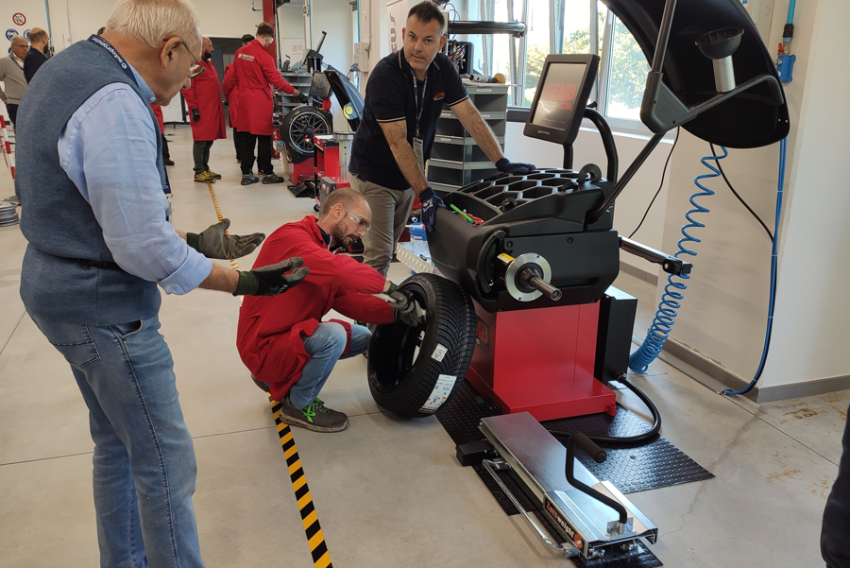
Tire vibration issues
A vehicle traveling at high speed is subject to a wide range of vibrations that are transmitted to passengers physically or acoustically. The vibrations may be caused by the wheel, or the wheel itself may act as a vibration transmission system. In the latter case, the vibration is transient and ceases when its source ceases. When the cause is the wheel, however, the vibrations occur continuously and independently of the road surface. The causes are variations in lateral and vertical force, which occur on the wheel axle itself.
The main cause of vibration attributable to the wheel system is imbalance. This can be caused by a defect in the tire and/or rim, particularly if it has been subjected to impact or repairs, incorrect positioning of the masses during balancing, a bead seating error, or incorrect tightening of the rim on the hub.
Imbalance can be static or dynamic: the former causes vertical jolting of the wheel, which is transmitted mainly to the bodywork, while the latter causes lateral oscillation of the wheel in a transverse direction (fluttering), which results in a series of oscillations of the steering wheel around its axis.
An unbalanced wheel wears the tread abnormally and can cause damage and premature wear to the steering/suspension system. The purpose of balancing is to eliminate or minimize wheel vibrations that cause driving disturbances and, over time, damage to mechanical components by compensating for unbalanced masses. Balancing a rotating mass, such as a wheel, means distributing the masses symmetrically with respect to the axis of rotation and with respect to the plane of symmetry orthogonal to the axis of rotation passing through the centerline of the wheel itself. This is achieved by placing compensating masses—counterweights—on the sides of the rim. The size and position of the counterweights to be applied to the inner and outer edges of the rims are determined by the balancing machine.
The balancing process
Cones or bushings are used to secure the wheel to the mechanical shaft of the balancing machine and ensure correct and precise centering. The most commonly used system is the cone, which is inserted into the rim exclusively from the machined side of the hole, i.e., the side with a countersink or a special bend in the sheet metal. The cone cannot be used for rims without a center hole or for those where centering on the hub is done not with the center hole but with the mounting holes. Given the importance of precise centering, the Federpneus National School recommends the use of the mounting-centering kit, which allows for better centering of the rim thanks to its low angle and high-precision machining. In fact, in the case of cones with a high construction angle, it is more likely that the rim will be positioned on a plane that is not perfectly perpendicular to the shaft.
The bushings to be inserted on the cone are recommended by some car manufacturers and designed specifically for each vehicle. Having a low taper, they allow for very precise centering. For some very heavy alloy rims, a bushing and a flange with pins are used, which are inserted into the holes in the rim, distributing the pressure evenly as if the rim were mounted on the wheel. Bushings are also used for wheels that need to be centered in the mounting holes and not in the center hole; in this case, the cone acts as a pre-centering device.
Balancing in 7 steps
Before proceeding with balancing, make sure that the rim is completely clean and, if necessary, use detergents that will not corrode the paint
- Insert the cone into the rim hole, paying attention to the size of the hole and the rim
- Lock the wheel at the end of its travel with the cone
- Make a first throw by hand, checking that the wheel turns freely, that the centering is correct, and that there are no irregularities in the rim or wheel.
- Start the balancing procedure
- Read the static and dynamic imbalances
- Apply the internal and external counterweights, and the hidden weight if necessary
- Optimize the wheel system