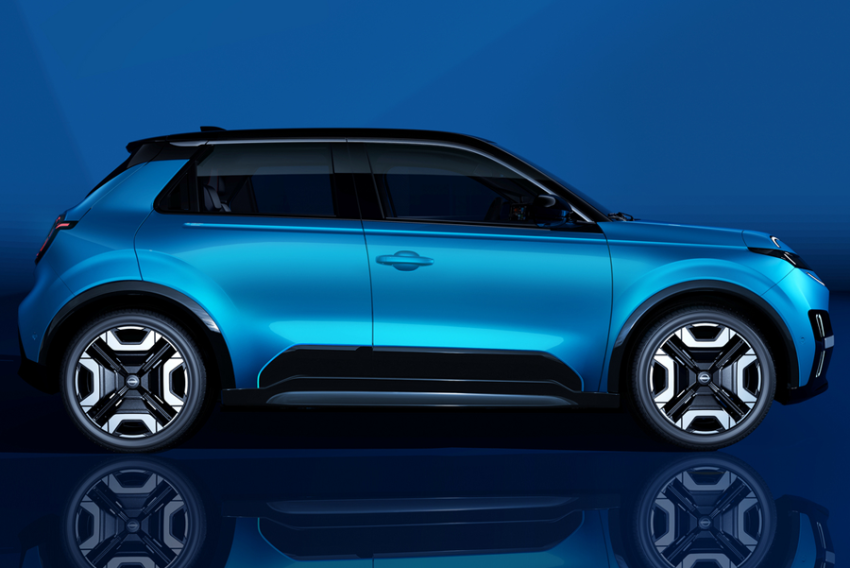
Forty-four consecutive years. That is the time span separating the first Micra from the present day. An era that has seen five generations of the popular Japanese compact car come and go—previously equipped with diesel and gasoline internal combustion engines—leading up to the radical transformation of this sixth version. A revolution introduced in late 2025 as an EV, with a focus on environmental sustainability, designed to meet the latest demands for green mobility—especially in urban settings and for short- and medium-distance trips—and perfectly suited to European cities. And when needed, it can even transform into a true power bank for external applications, thanks to bidirectional energy exchange.
Japanese with a European Soul
It bears the emblem of the Land of the Rising Sun, but beneath it lies a transalpine identity. In fact, the new Micra is the alter ego of the Renault 5 Tech Electric, designed at Nissan Design Europe (NDE) in London and built at the Renault Ampere ElectriCity plants in Douai, northern France—the very same production lines where its cousin, the R5, is also brought to life. Significantly larger than that first compact model from way back in 1982, the current version features dimensions in line with those of the B-segment it belongs to, with a length of just under 4 meters (3.97 m to be precise), a width of 1.83 meters—excluding side mirrors—and a height of just 1 millimeter less than 1.5 meters. Adequate space for five occupants is ensured by a wheelbase of 2.54 meters, which—together with a compact rear-end design and the slim battery pack mounted lower in the vehicle—also guarantees a cargo capacity of 326 liters, expandable to 1,106 liters by folding down the rear seats. There is no spare tire or spare wheel to avoid taking up valuable space; in the event of a flat tire, a repair and inflation kit is provided. The aesthetic impact is truly distinctive, with a grille dominated by two stylized, rounded headlight clusters—featuring LED technology, just like the taillights—along with the front logo and a slim lower air intake to allow the electronic system to “breathe,” cooling—or heating—the batteries for optimal efficiency.
Five doors, a high waistline, and rear door handles integrated into the C-pillar define the sides, framed by striking wheel arches sized to accommodate the generous 18-inch wheels—the only option available across all trim levels—which give the car a muscular look. The exterior overview concludes with the rear section, whose design elements echo those of the front, most notably the round taillights connected by a horizontal trim piece, topped by a slanted rear window that tapers toward the roof via a subtly hinted-at spoiler. Upon opening the door, two visual elements catch the eye inside the cabin: the 10.1-inch TFT display in front of the driver, which can be customized as desired and displays the digital instrument cluster and all driving information, as well as the 10.1-inch central dashboard monitor, where you can view navigation maps, infotainment functions linked to your smartphone, climate control, driving modes, and remaining range. The integration of Google Assistant into the system allows you to control numerous functions via voice commands, eliminating the need to take your eyes off the road, while the NissanConnect app provides a remote overview of the vehicle’s status, such as parking location, battery status, and climate control settings.
Two Powertrains, Two Functions
Built on the CMF-B platform—shared with the latest hybrid and internal-combustion sedans from the Franco-Japanese alliance, renamed AmpR Small and modified in the central section to accommodate the EV versions’ battery pack under the floor—the Micra, unlike previous models, no longer features internal-combustion engines, —both diesel and gasoline—and gains an electric motor in the name of environmental sustainability. With two levels of electrification, the available trim levels offer 90 kW (120 CV) or 110 kW (150 CV) of power, both at 400 volts, with maximum torque of 225 and 245 Nm (22.9 and 25 kgm), respectively, immediately available at the first touch of the accelerator. For this electric powertrain, engineers from the Franco-Japanese alliance opted for a wound synchronous rotor instead of the more common permanent-magnet motor—a solution offering comparable performance that eliminates the need for rare earth elements required to manufacture the magnetic components. Categorized according to the two power levels offered by the powertrain, the batteries located under the floorpan use nickel-manganese-cobalt (NMC) batteries, with a capacity of 40 kWh for the first and 52 kWh for the second. These batteries feature higher energy density and therefore offer better performance—but are also more expensive—than lithium-ion batteries. Charging times have been significantly reduced, allowing a charge from 15% to 80% in 30 minutes when connected to an 80- or 100-kW DC charging station, or 3.5 hours to fully recharge (starting from a minimum of 10% remaining charge) from an 11-kW AC power source, plus one additional hour for the version with the larger battery.
The Micra’s platform, like that of its cousin the Renault 5, features an independent four-wheel suspension layout, front-wheel drive, electric power steering, and disc brakes with automatic regenerative braking, which provide excellent handling, comfort on long drives, and maneuverability in urban settings and when parking—all automated via Hands Free Parking assistance. The ADAS active driver-assistance systems, managed by Nissan’s ProPilot Assist, are invaluable, including adaptive cruise control, automatic emergency braking, and lane departure prevention. The e-Pedal system is also standard, allowing the driver to accelerate and decelerate using the same pedal, adjusting the level of regenerative braking via paddles behind the steering wheel, all the way to a complete stop without necessarily having to apply the brakes. With a curb weight ranging from 1,400 to 1,524 kg, the Micra offers a balanced performance between acceleration and range, with a top speed limited to 150 km/h and 0-100 km/h acceleration times of 9 and 8 seconds, respectively. The vehicle’s response modes can be adjusted across four levels set by the driver: Comfort, Eco, Sport, and Personal, allowing drivers to customize their settings as desired. The range rated under the WLTP cycle is impressive, with maximum ranges in Eco mode of 310 or 408 kilometers—obviously with zero emissions—depending on the two battery capacity levels. The wheel system comes in a single size, with 18-inch steel or aluminum alloy rims, all fitted with 195 mm-wide tires and a 55% aspect ratio. The ever-growing demand for flexibility, as well as for the optimization of energy resources, is met by V2L (Vehicle to Load) technology, which acts as a mobile battery to power external devices when the vehicle is not in use—such as e-bikes, laptops, and even a vacuum cleaner, if you manage to bring the car into your living room.