This issue inaugurates the Technical Tips column in collaboration with the Federpneus National School. Through the knowledge and experience of Gabriele Lazzarini and Flavio Marchi, both instructors at the School, the column will provide practical advice that specialist tyre retailers can use in their workshops. More than 800 tyre specialists have already attended training courses organised by the Federpneus National School since 2016. The lessons—both theoretical and practical—are aimed at improving professional skills and keeping up to date with technological developments in the world of tyres. These sessions are reserved for Federpneus members and take place in the School’s workshop, fully equipped thanks to collaboration with AICA (Italian Garage Equipment Manufacturers Association) and associated companies that have supplied the School with their latest service and maintenance products: Commerciale Lmv, Corghi, Cormach, Dino Paoli, Mak, M&B Engineering, Ravaglioli, Rema Tip Top Italia Automotive, Sipav – Cemb, and Stahlwille Tools. In this edition of Pneurama, which features a special section dedicated to the truck world, the Technical Tips column will illustrate the benefits of correct wheel and axle alignment in commercial vehicles.
Wheel and Axle Alignment in Commercial Vehicles
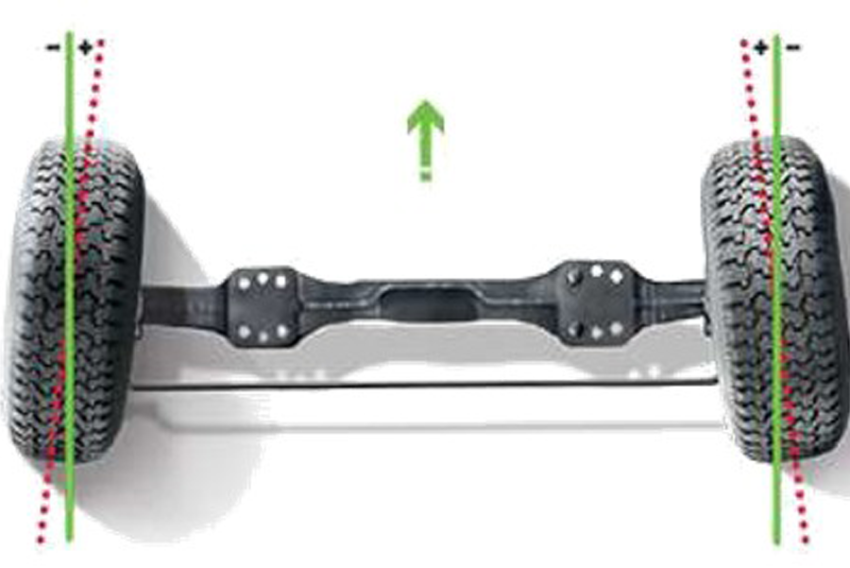
A study conducted by CSMT of Brescia and promoted by Pesci Attrezzature, the Italian JOSAM distributor and Federpneus trainer, has shown that correct wheel alignment increases savings both on fuel costs (a 10% reduction in fuel consumption per kilometre, with a corresponding reduction in pollutant emissions) and on mechanical and tyre wear (15% reduction in tyre consumption per kilometre, resulting in less environmental microplastic dispersion). But that’s not all. Proper checks and regular alignments allow vehicle owners to detect any misalignments in good time, increasing vehicle uptime, thereby improving overall profitability, while reducing the risk of accidents and driver fatigue. For workshops, correct alignment means increased business, with more satisfied customers and greater professional recognition. Knowing how to perform a correct alignment means avoiding some of the common pitfalls associated with this operation. Among the most widespread errors, which we highlight to help prevent them, are misalignment, incorrect toe and camber settings, incorrect steering wheel position, combined misalignments, and non-parallel axles. When the rear axle is slightly out of its natural position, even by a small margin, the vehicle becomes misaligned causing excessive tyre wear, often affecting the connected trailers. This kind of defect is a road safety hazard, as it can lead the vehicle to occupy too much of the carriageway and cause unexpected driving responses. Incorrect toe makes the tyres subject to excessive wear, reduces directional stability, and increases braking distances. The tyre graining, which increases internal or external shoulder wear, raises rolling resistance and consequently fuel consumption. The main cause of this defect is poor grip from the front wheels, leading to steering instability and increased wear of mechanical parts linked to the axles. Incorrect camber may occur due to structural damage to the vehicle, when suspensions are weakened by time and use, or if certain components—such as track rod ends—are particularly worn or defective. The effects of incorrect camber include increased braking distances, uneven tyre wear making driving unstable, and excessive abrasion of the wheel bearing. An incorrect steering wheel position can mainly be caused by an incorrect position of the steering box, incorrect toe of the front wheels, or the positioning of the front axle wheels not matching the steering alignment. Combined misalignment of the front and rear axles, in addition to causing greater tyre and fuel consumption, can represent a real safety hazard by making the vehicle very unstable and causing it to occupy excessive space on the carriageway. The rear axle “thrust line” not being aligned can lead to a “dog run” effect and more pronounced wear on the shoulders of the front steer tyres, with effects similar to those of incorrect toe.