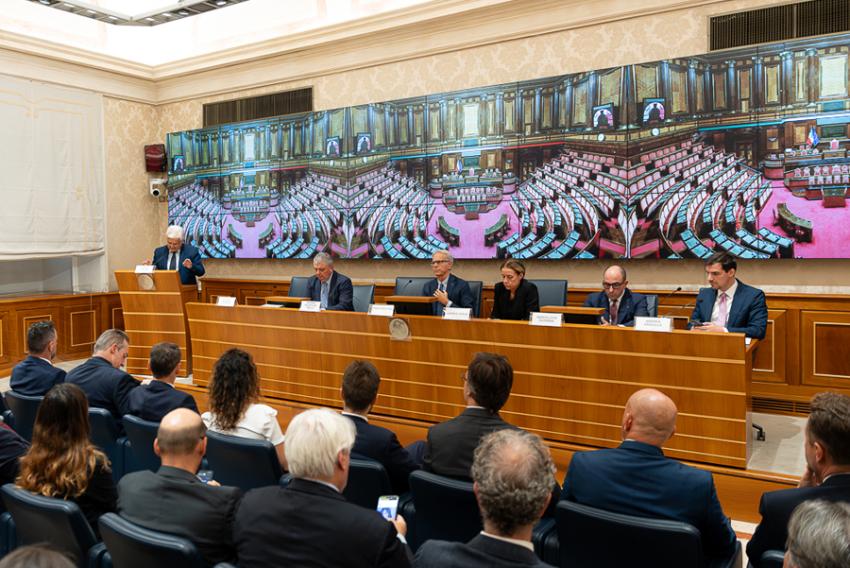
At a time when the use of strategic resources should by now be fully aligned with the principles of circularity and sustainability, the Italian and European retreaded tyre market paradoxically continues to suffer from competitive pressure from low-cost products, which have an environmental impact that is no longer sustainable. To raise awareness amongst public decision-makers of the sector’s strategic importance and the significant contribution it can make to the competitiveness of the Italian manufacturing sector and the development of the circular economy, an event entitled ‘Tyre retreading: a strategic lever for the revitalisation of Italian industry’ was held in the Senate on 10 September. The initiative, launched at the instigation of Senator Antonio Trevisi and organised with the non-binding support of AIRP (Italian Tyre Retreading Association) and its member companies Bridgestone and Michelin, brought together institutions, industry representatives and trade associations to discuss the sector’s prospects. According to the study “Ricostruire Valore” presented by Fabio Orecchini, Full Professor of Energy and Environmental Systems and Director of the Car and Mobility Observatory at Luiss Business School and Guglielmo Marconi University, “the global retreaded tyre market shows solid growth prospects and is estimated to be worth up to 18 billion dollars by 2031–2036, with annual growth of up to 8.5 per cent. In Europe, however, the rise in imports of low-cost products is threatening the sector, and in Italy volumes have more than halved over the last 15 years, thereby also diminishing the significant environmental benefits that retreading offers”. The study therefore outlines a strategy of “supported recovery”, through measures aimed at revitalising the supply chain. “Tyre retreading plays a key role not only because of the significant environmental and economic benefits it offers, but also as a lever to revitalise the entire European tyre industry, which at this historic moment is suffering from a combination of various adverse factors. Supporting retreading therefore means promoting not only sustainable transport and Italian manufacturing, but also the premium tyre industry, which has production assets of strategic importance in our country,” added Stefano Carloni, President of AIRP. According to Laura D’Aprile (Head of the Sustainable Development Department, Ministry of the Environment and Energy Security), “to support the market for recycled, reused and retreaded tyres, in addition to extended producer responsibility, we have two downstream tools: the CAMs (Minimum Environmental Criteria) and the ‘End of Waste’ designation. The CAMs are made mandatory by the Public Procurement Code. We have recently put a joint document out for consultation on the ANAC and MASE websites, which strengthens controls over the CAMs — a process already set in motion in ANAC’s Three-Year Plan.
At European level, the new Circular Economy Act is moving in the same direction; the Commission is expected to present its proposal by the autumn: it will aim to boost demand for recycled and remanufactured materials, including through the strengthening of green public procurement, providing us with further levers to support this process in the coming months. We are also examining the issue of sanctions: when non-compliance is widespread and does not abate despite training or ANAC’s warnings, we must also consider the use of sanctions.”
Senator Antonio Trevisi, the event’s organiser, stated: “Tyre retreading is a very important issue for me because it is a fundamental pillar for creating new economic activities on the one hand, and for safeguarding the environment on the other. Obviously, we must also communicate this effectively to consumers so that they understand that a retreaded tyre is just as good as a new one and that the vehicle therefore does not lose any performance.” Among the politicians who spoke was Senator Antonino Germanà (Secretary of the 8th Environment Committee): “It is the committee’s duty to address this issue and bring it to the attention of Parliament. I am committed to supporting you in this, starting with the possibility of a series of hearings in the run-up to the budget or some specific regulatory measures”. He was followed by MP Massimo Milani (Secretary of the 8th Environment Committee): “Tyre retreading is a strategic sector for Italy, as it helps reduce energy and raw material consumption and strengthens the industry’s competitiveness. However, the sector must contend with growing competition from Asia and dumping practices, which require a response at European level. In this context, the circular economy is not merely an environmental choice but an instrument of industrial policy: recovering secondary raw materials means reducing dependence on foreign sources and safeguarding European production.” According to Fabien Sibeaux, Truck Sales Director at Michelin Italia, “the retreaded tyre represents a concrete lever for the circular economy and a strategic asset for the national economy. Making the most of casings designed to last longer means strengthening the competitiveness of fleets and the supply chain and reducing the use of new raw materials, thereby helping to lessen the environmental impact of transport. It is a solution that is already available, safe and high-performing, combining sustainability, innovation and industrial value”. Meanwhile, Vicente Marino, Head of Bridgestone for the Southern Region and Commercial Director at Bridgestone, emphasised that “the transition towards a more sustainable model also depends on the ability to make the most of what already exists. In the transport sector, preserving the value of a tyre throughout its entire life cycle means using resources, materials and energy more efficiently, whilst reducing environmental impact. Retreading is a concrete example of the circular economy applied to mobility and an important lever for strengthening industrial competitiveness, resilience and the sustainability of the national economy”.
According to Marcello di Caterina, Vice-President and General Manager of ALIS (Association for Sustainable Intermodal Logistics), “tyre retreading is a driver of competitiveness for the Italian manufacturing sector, of the development of the circular economy and of reducing environmental impact. ALIS took part in the MASE public consultation on the revision of Ministerial Decree 182/2019, reaffirming its commitment to the effective and circular management of end-of-life tyres. The Association supports the introduction of a tax credit for the purchase of retreaded tyres, as a means of transforming circularity into a concrete driver of development”.
Andrea Arquilla, Head of European Institutional Relations at ANITA, concluded by emphasising that “for road haulage companies, retreaded tyres represent an opportunity to transform waste into suitable resources, helping to limit the use of new raw materials and the further production of waste, with positive impacts on the environment, company balance sheets and transport safety. In this regard, EU legislation provides safeguards capable of overcoming prejudice, and heavy goods transport operators are doing their part to consolidate this circular economy supply chain”.
The 64th AIRP General Meeting of Members in Treviso
The 64th AIRP General Meeting of Members was held in Treviso on 2 October, providing member companies with an opportunity to take stock of ongoing activities and the various areas of work in which the association is involved. In his opening address, President Stefano Carloni, after outlining a market situation that continues to be challenging for retreaded tyres, emphasised the association’s commitment to institutional activities, which culminated in the event on 10 September at the Senate and in parallel efforts to secure concrete measures to support the sector. Another issue raised by the President was that – which also emerged clearly during the preparations for the Senate event – of the perception of retreaded tyres, which remains tied to old stereotypes regarding safety: a view now far removed from reality, and on which the association should take specific action. The report by Secretary-General Guido Gambassi then outlined the main regulatory developments of interest to the sector, starting with the EUDR regulation on deforestation, which this year underwent a significant amendment that effectively excludes retreaded tyres from its scope; However, important measures such as the introduction of labelling for retreaded tyres and the Ecodesign Regulation for tyres are still under development. Among the activities recently launched by AIRP, mention was also made of the launch of the association’s social media channels, alongside the implementation of a specific communication plan. Part of the general meeting was also devoted to discussions with representatives from Michelin and Bridgestone, both of which are AIRP members in their capacity as manufacturers of new tyres and who had already supported the association at the recent institutional event in Rome; on this occasion too, they reaffirmed their commitment to supporting retreading, starting right from the design stage of the new tyre. Elections were also held during the general meeting to renew the association’s Executive Board. The member companies that will make up the Board for the two-year period 2026–2028 are: BR Pneumatici, Carloni, Carloni Pneumatici, Com-Var, La Lombarda, Malatesta Sud, Marangoni, Piave Tyres, Rigomma, Rinovis, Sicur Tyres Group, Tessilgomma and Veneto Gomme. The posts of president, vice-president and treasurer will be allocated amongst the board members during the Board’s first meeting.