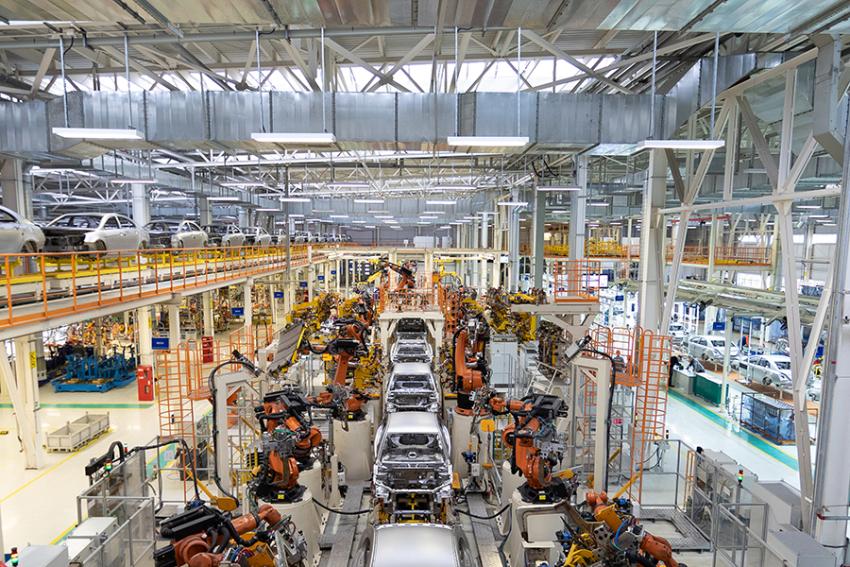
The automotive sector is still on a rollercoaster between the pandemic driven crisis and bouts of recovery. For example: August was a rather positive month followed by a dismal September. In August, in fact, the turnover of the automotive sector, as a whole, showed a positive variation of 2.7%, with the domestic component growing by 0.4% and the foreign component by 5.2%. In the cumulative January-August 2021, turnover increased by 45.1%, with domestic turnover up 57.1% and foreign turnover up 30.9%.
Furthermore, turnover from motor vehicle parts and accessories showed a decrease of 0.8%, -2% for the domestic market and -0.1% for exports. Then came the September anti-climax, with Italian automotive production showing a double-digit drop at -12.1%. Gianmarco Giorda, director of Anfia, commented: "The most significant elements determining this contraction can be recognized in the lingering microchip shortage and the end of resources allocated to new vehicle purchase incentives for cars with emissions from 0 to 60 g/km of CO2, which was then refinanced but with resources available again only from 27 October, and depleted in less than two days. Negative effects of too many syncopated incentives that we hope will not be repeated in 2022, thanks to the introduction, in the Budget Law, of a three-year structural measure to support low emission passenger car and the light commercial vehicles, as part of a plan to accompany the energy and production transition of the sector. As far as production of parts and accessories for motor vehicles are concerned, the production index increased by 17.9% in the month, but mainly because September 2020 showed a sharp decline (-23.8%), and also exports in the first 7 months of this year closes with a plus sign compared to the same period of 2020 (+32.3%)".
Talking about ups and downs, the automotive manufacturing sector fits within an overall Italian industrial production that has been growing since March 2021, after 24 months with a minus sign: in September 2021, the industrial production index as a whole closed at +4.4% compared to September 2020, but -0.5% compared to September 2019, and is up 14.6% in the first nine months of the current year compared to the same period in 2020, but down 1.9% compared to January-September 2019. This complex scenario also includes the financial implications given by the renewal of the national contract for Logistics, Goods Transport and Shipping, which provides for a one-off payment of 230 euro divided in three instalments and an increase of 90 euro on the minimum wage paid in four instalments from October 2021 to March 2024. In the October 2021 pay-check, workers will find the second instalment of the one-off payment, equal to 50 euro, in addition to the 100 euro received in July. The third instalment of 80 euro will be paid in April 2022. Expected is also a salary increase that varies according to the professional level from 11.36 to 19.20 euro before taxes. The amount of the one-off payment is not considered for the purposes of the severance pay and other contractual benefits and is reduced proportionally for part-time contracts.
All this while at international level, but with important repercussions on our market, transport scenarios are changing.
For example, 99% of express parcels delivered in 2020 in the United States were handled by just four operators: the public postal service Usps, couriers such Ups and FedEx and the logistics division of Amazon. The latter, despite the recent arrival in the parcel delivery service sector, has already reached the third position in terms of percentage of volumes transported, with 21%, starting from one percent in 2015, thus surpassing FedEx, which dropped from 22 percent in 2014 to 16 percent in 2020. Now Amazon Logistics is closing in on Ups, also down from 39% in 2014 to 24% last year. Usps (also used by Amazon) still holds top spot despite a rather complex trend: 38% in 2020, the same percentage as the previous year but lower compared to the peak of 43% reached in 2017-2018. However, it started from 37% in 2014, so for now it is still managing to keep a distance from Amazon Logistics.
These figures were released by Pitney Bowes, also involved in this business, which specifies, however, that the market share does not completely explain the situation, as in recent years Ups and FedEx have been selecting shipments, focusing on B2B. Despite the soaring figures, Amazon is forced to use third party carriers, also because the volumes have been increasing dramatically. In 2020 the total shipments were 4.2 billion, of which 2.8 carried out by third-party carriers.