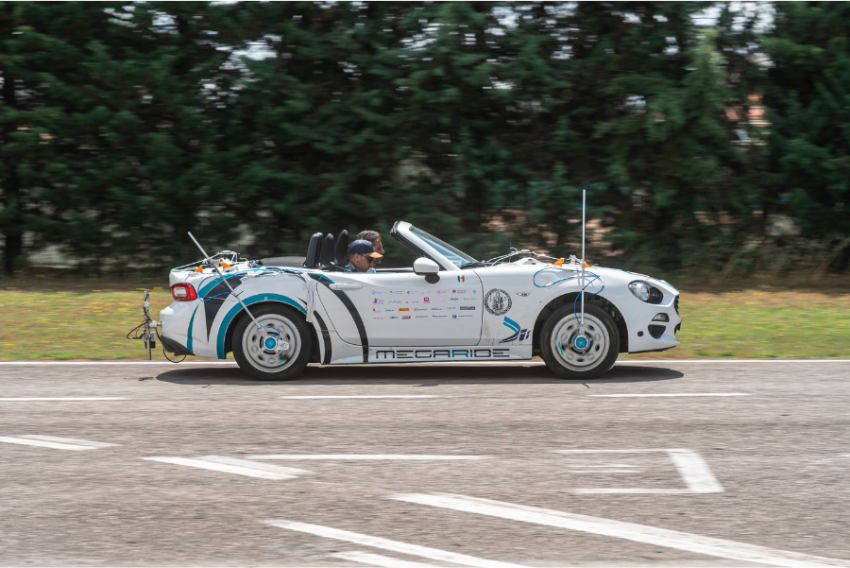
From a spin-off of the University of Naples Federico II to a deep-tech company. This is the story of MegaRide, a technology firm active in the automotive and motorsports sectors, capable of developing innovations based on scientific and engineering discoveries. It is precisely thanks to numerous research projects on the interaction between tires and the road that the real-time models MegaRide has brought to market took shape; these are now used in analysis environments and on the world’s leading driving simulators to improve vehicle performance. Founded in 2016, MegaRide—named after the ancient islet where Castel dell’Ovo stands, which tradition links to the myth of Partenope and the city’s origins—has grown exponentially. Over the past ten years, the company has established partnerships with major brands in the automotive sector and undertaken numerous projects with various teams in Formula 1, Formula E, MotoGP, and NASCAR. This journey has allowed the company to increasingly shift its business—which began in motorsports—toward industrial applications. The work carried out by the founders—Flavio Farroni, Francesco Timpone, and Aleksandr Sakhnevych, all professors and researchers in the Department of Industrial Engineering at UniNa—has made MegaRide a major technology transfer holding company, which today employs more than 50 professionals and has a turnover of approximately 3 million euros.
From the laboratory to industrial applications
Behind MegaRide’s growth lies the RaceArch Lab, the research infrastructure developed in the laboratories of the Department of Industrial Engineering at the University of Naples Federico II by the UniNa Vehicle Dynamics research group. This infrastructure has been strengthened over the years thanks to the company’s direct contributions, including investments in technical equipment, funding for scholarships, and projects with major industrial partners. MegaRide’s goal is to provide automakers, tire manufacturers, and motorsport teams with data and models on tire performance under various operating conditions. It was from these studies, in fact, that VESevo was born—an acronym for Viscoelasticity Evaluation System – Evolved—an innovative device that has revolutionized the way tire tread viscoelasticity is studied. This tool analyzes tread quality and wear through simple contact without the need to remove samples, as is traditionally done. In practice, VESevo allows for the evaluation of two fundamental aspects of tire behavior: how it reacts to stress and how much energy it dissipates during contact with the asphalt. The process works by utilizing the mechanical stresses produced by a metal rod, tipped with a hemisphere, launched against the tread by a precision mechanism. Software analyzes the “bounces” of this probe to determine the properties of the compound at a given temperature, which is simultaneously detected by a sensor. It is no coincidence that the motorsport world’s interest in this technological innovation was almost immediate. VESevo allows teams to evaluate tire performance and plan race strategies. The system offers a non-invasive reading of key parameters, enabling teams to optimize the vehicle’s aerodynamics and suspension. However, the use of this device is not limited to motorsport alone. Its application also extends to the tire industry. Manufacturers of car or motorcycle tires can conduct rapid tests directly on the production line to assess batch consistency and measure the uniformity of characteristics. This optimizes the prototyping and testing phases, reducing development time and costs.

MegaRide, the company that develops algorithms for high-tech tires