Wheels
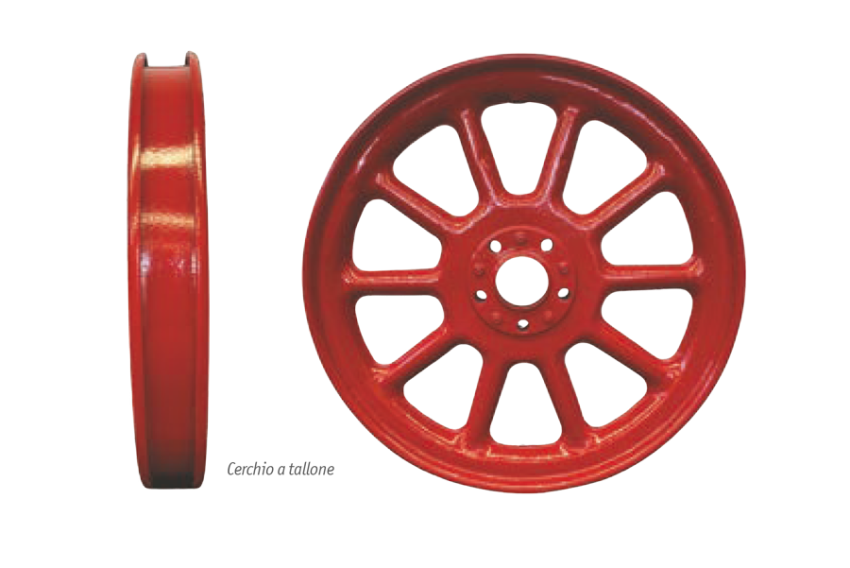
When a tyre specialists receive a classic car in their workshop, they may encounter the following types of wheels: bead-lock rims, rim-type, half-channel rims, full-channel rims, and tubeless. Before offering some useful advice for their maintenance and sourcing, let us briefly recall the main characteristics of each wheel type.
Bead-lock rims, usually made of wood or with iron spokes, are designed so that the tyre is fitted into the bead. Cars produced between the 1920s and 1930s, may feature rim-type spoked wheels, assembled with a metal ring featuring a groove to lock the tyre. The specific nature of the rim makes mounting particularly dangerous: if the ring is not properly locked in place, it can be violently dislodged during tyre inflation. Half-channel rims can be either spoked or made of rolled and welded sheet metal and are often used with tyres that have sizes indicated in millimetres (e.g. 145 R 400 or 165 R 400). Full-channel wheels can be spoked, made of iron, alloy, or bi-metallic (half aluminium and half metal sheet). Finally, tubeless rims more common on cars produced from the 1950s onwards. Equipped with an appropriate valve, these can be spoked, made out of metal, or alloy (aluminium or magnesium).
Restoration and new production
Where still available, vintage wheels require, depending on type, appropriate restoration before reuse. In the case of magnesium alloy wheels, it is advised to exercise maximum caution during restoration assessment. Magnesium, over time will develop internal porosity, which can weaken the structure and eventually cause the wheels to crumble. Restoring aluminium alloy or forged aluminium wheels does not present any particular problems. Their restoration involves checking the condition of the wheel (as impacts may have caused deformation), straightening by heating the aluminium, and finishing with a galvanic bath. Ruote Borrani Milano a company specialising in restoring spoked wheels, has been active since 1922. They restore products for high-end cars from the early 1950s backwards, and replicate historic wheels from their archive for sports cars, Formula 1 and other competition vehicles (until 1960, 90% of the wheels used in Formula 1 came from their factories). In addition to restoring spoked wheels, Borrani deals with the refurbishment of full-channel or half-channel wheels from their old catalogue, with the necessary precautions. For example, Dial wheels created between the late 1960s and early 1970s feature an iron channel; therefore, restoration is only carried out if the channel's condition allows. Body shops can strip paint, sandblast and straighten the rim edges. If the edges of the rims have been damaged, they can be repaired using a lathe. Another option for sourcing classic car wheels is the new production of historic wheels. There are companies specialise in reproducing old wheels for Porsche, Fiat 500, Ferrari and others, relying on reverse engineering to redesign historic wheels and reindustrialise their manufacturing process.
Advice for tyre specialists
Some precautions during mounting, balancing, tightening and maintenance procedures. Bead-lock wheels should be mounted and removed exclusively by hand using curved levers. When fitting tyres to half-channel wheels, pay attention to the direction. If not fitted in the correct direction, the tyre will deteriorate rapidly. When working on tubeless wheels, it may happen that the area behind the valve hole is rusty or corroded. In this case, the valve may not seal perfectly; to resolve this, the tyre specialist can refit the tyre with an inner tube. For spoked wheels with central nuts, tightening should be carried out with a lead, copper or Teflon hammer. For this type of wheel, wire balancing is recommended. Furthermore, in cars produced up to the 1950s, with light alloy wheels, it often happens that the tightening bolts have a direction (right – left). In this case, particular attention must be paid to distinguishing the direction when tightening the bolts and always use a torque wrench. For iron or light alloy wheels, tightening should be done with a torque wrench, not with an impact gun, which risks deforming the nuts, often made of brass or duralumin. For iron wheels, spring lead balancing is recommended, while for alloy wheels adhesive lead weights is advised.

Maintaining and Restoring Vintage Wheels