Starting with this issue, Pneumatici d’Epoca will dedicate each issue to an iconic model from the classic car scene, exploring its technical characteristics with a specific focus on tires, rims, and their maintenance.
Lancia Aprilia and Ardea
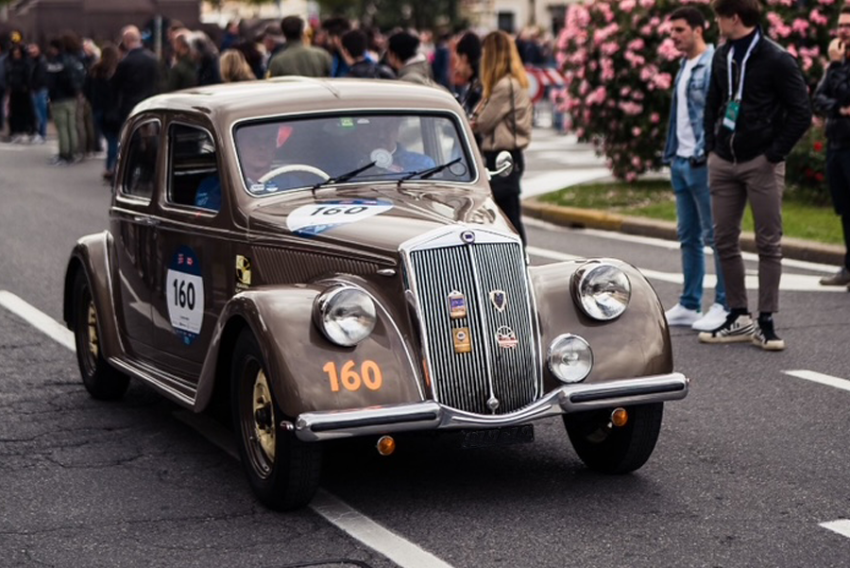
In 1935, Vincenzo Lancia completed the design of a prototype that would prove to be extremely modern. The car was unveiled to the public at the 30th edition of the Paris Motor Show in October 1936 under the name Ardennes, later changed to Aprilia when production began in early 1937. Its brilliant creator, however, was unable to witness the extraordinary reception it received. Vincenzo Lancia died prematurely on February 15, 1937, at the age of 56. The Aprilia was, in fact, an innovative car in every respect. A compact four-door sedan (with wing-door styling and no B-pillar), it was powered by a 1,352 cm³ V4 engine delivering 47.8 CV at 4,300 rpm and featuring overhead valves, along with independent suspension on all four wheels (a Lancia patent).
Thanks to the invention of the wind tunnel, industrial design began to seek better performance for motor vehicles through improved aerodynamics. The influence of this research is reflected in the sinuous and sleek lines of the monocoque body of the new Lancia Aprilia.
From 1937 to 1949, 21,436 units were produced. There were many interpretations by coachbuilders on chassis for custom-built models, but there were also numerous sports versions that brought the Lancia brand back into the world of racing, even triumphing at the 1947 Mille Miglia in the Turismo class up to 1,500 cc.
A curious anecdote attests to the innovation behind this car. In June 1936, after nearly a year of road testing, Vincenzo Lancia—on his way to Bologna—put the Aprilia prototype through its paces, reaching 130 km/h, a speed unimaginable for those times.
In 1939, it was the Ardea’s turn, featuring an engine of just 903 cm³—the smallest Lancia had built up to that point. As with the Aprilia, production of the Ardea resumed after the war (Series III and IV) with several improvements.
Tires
The Aprilia Series I was equipped with 130/140-40 tires, the same textile tires previously tested on the Lancia Augusta. In 1946, Michelin invented the radial tire, and the Aprilia was the first car to be fitted with this type of tire, in the 165/400 size, initially called “radiale stop” and later renamed the Michelin X.
The Ardea inherited all of the Aprilia’s technology, including its tires: 145/400 “radiale stop,” which later became the Michelin X.
When replacing the original tires, it is preferable to use the Michelin X line; alternatively, and only in the case of the Aprilia, you can opt for the Pirelli Cinturato. While the Michelin X has an SR speed rating and a very soft sidewall, the Pirelli Cinturato is a tire with stiff HR sidewalls which, due to its characteristics, is recommended for higher-performance racing. By stiffening the sidewall and increasing grip, the Pirelli Cinturato places greater stress on the Aprilia’s front end, which was originally designed for a different type of tire. For this reason, it is important to take the proper precautions before installing this type of tire—both with regard to the front end, to avoid the risk of torsion bar failure, and with regard to the rims, which, when subjected to greater stress, are at risk of damage to the flange.
Rims
When maintaining or replacing the rims on the Lancia Aprilia and Ardea, care must be taken because these models could be equipped with alloy rims. The first alloy rims, which were tested in the late 1940s, were detachable Gianetti rims—specifically, Streetside rims with a pull-out bead seat; therefore, if the steel ring that secures the tire to the rim is not perfectly seated, it can become dangerous. The tire models originally fitted to the Aprilia were not available in studded versions; therefore, in some cases—such as when participating in a regularity rally during the winter—15-inch Lancia Appia Series I rims can be used, modified to reposition the flange and make them suitable for mounting winter tires. For this reason, it is not uncommon to find Lancia Aprilias on the road equipped with 15-inch radial tires.
Suspension
The Lancia Aprilia was equipped with a rubber-mounted silent block steering rod. However, this type of rod does not ensure precise steering adjustment. In fact, toe adjustment is performed using eccentric bolts that are rotated until they reach a new hole, where a pin secures the setting. The fixed arrangement of the holes does not allow for precise adjustment down to the millimeter. Since the Aprilia has positive camber, the tire tends to bear more load on the outer corner; at the same time, the closed toe setting causes the tire to wear more on the outer side. To provide greater stability, stiffness, and precision to the steering, the owners of Officina Gamberini—specialists in tuning sports cars and vehicles competing in regularity rallies—have modified the original tie rod by replacing it with a newly designed tie rod that incorporates the latest technical advancements. The new bar features the Uniball system and, being made of steel, requires no maintenance, while also ensuring proper adjustment of the right and left toe-in. With the new system, simply tightening or loosening the bar is sufficient to achieve the exact degree of adjustment.
Officina Gamberini Classic Cars
Officina Gamberini was founded on April 3, 1971, by Sergio Gamberini, with the support of his father. Sergio’s passion for mechanics and his knowledge of the industry were rooted in the experience he gained at Officina Faccioli between 1964 and 1971. The presence, across from the Bologna Bus Station, of a dealership selling Kawasaki, Honda, and Volvo marked a turning point for the business: Gamberini entered the world of racing, initially on two wheels.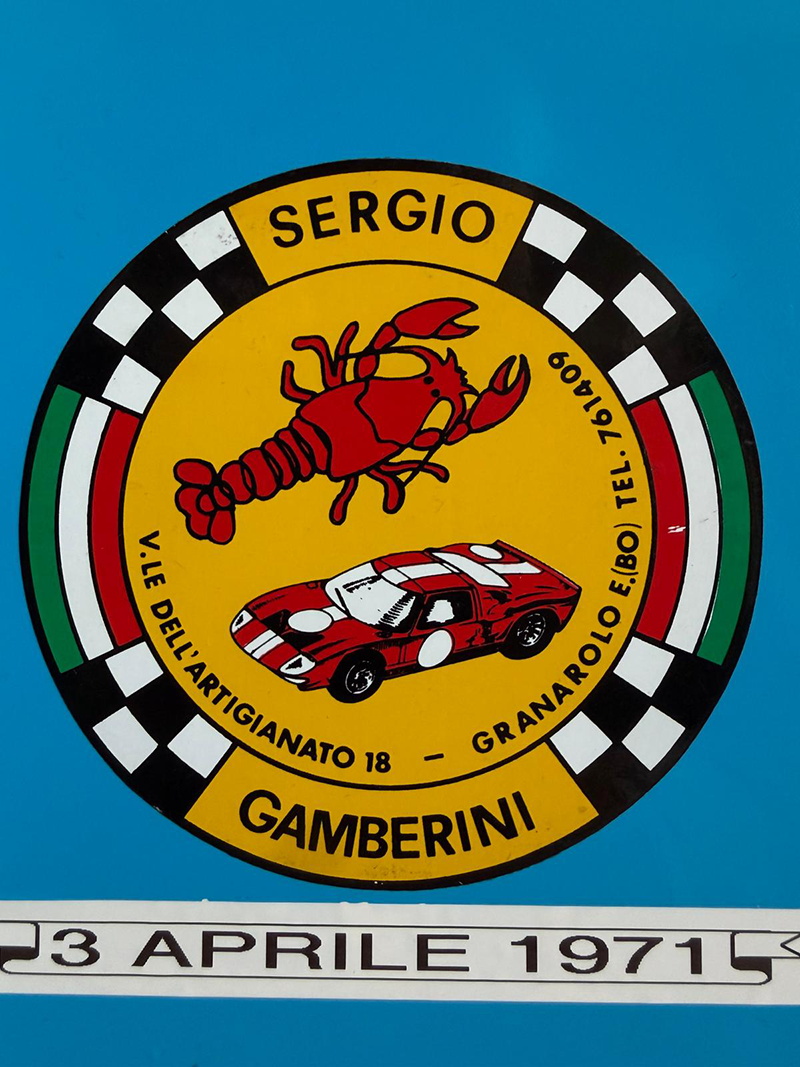 In 1974, in fact, he launched a maintenance service for Volvo cars and, on that occasion, came into contact with a Kawasaki inspector with whom he collaborated to upgrade a vehicle by installing two Alfa Romeo Giulia carburetors. In September 1979, a second significant turning point occurred: Edilberto Mandelli, a renowned collector of classic cars and founder of Scuderia del Portello, the HF Lancia Historic Cars Team, and Club Italia, identified Gamberini as the ideal workshop for maintaining his classic cars, starting with the Fiat 1100 Zagato. From that moment on, alongside the traditional business of repairing modern cars, the workshop gradually developed a specialization in the classic car sector. In 2022, the workshop was passed on to his son Vincenzo, who decided to devote himself exclusively to classic and race cars. This shift was officially recognized in 2023, when the business adopted the new name Officina Gamberini Autostoriche.