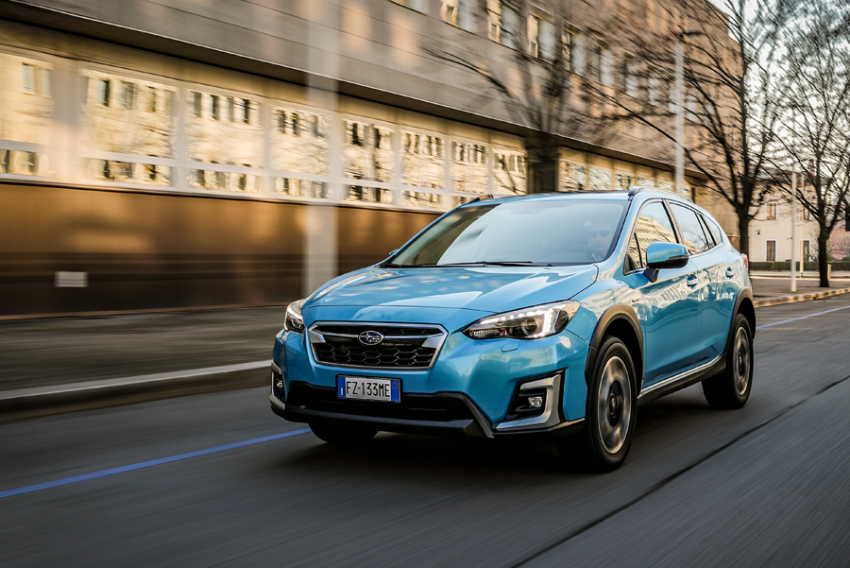
Never been one among many. When speaking of Subaru, one's thoughts turn to the philosophy that has made the Japanese brand famous: balanced weight distribution, symmetrical traction on two axles, opposed-cylinder engines and a low centre of gravity. All factors that have decreed the success of the Japanese hatchbacks, both commercially and in motorsports, as the true antagonist to cars that far too often resemble each other with little or no difference.
Engineering such factors produced noteworthy alternatives in the sport utility segment as well, first with the Outback and Forester back in the mid- and late 1990s - original station wagons with unusual off-road capabilities – followed by the XV (X for cross and V for vehicle), which made its debut in 2011, a sedan-like vehicle with the performance of a true SUV. Principles confirmed by the second generation XV, launched in 2018, all new thanks to the all-new SGP platform, now further refreshed thanks to the 2021 restyling.
Tough Explorer
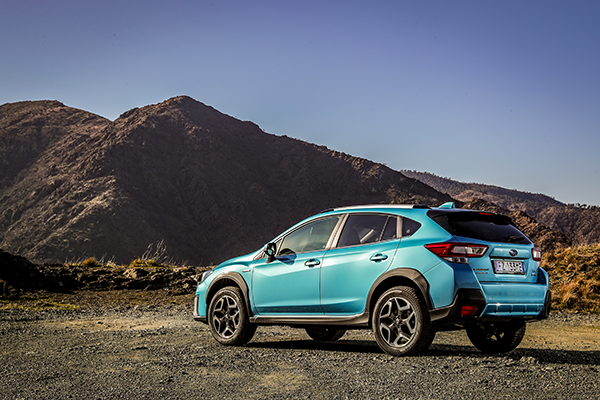
The extended on-off-road mobility offered by the XV is expressed by the "Tough Explorer" concept, which makes adventure its target and allows this Subaru to wiggle its way out of city and suburban traffic as a true middle-class compact vehicle. At the same time, the XV can serenely cope with dirt roads, snow-covered roads and even natural terrain, with far more ease than most competing sport utilities, at least up to the limit imposed by the characteristic angles, approach-break-over-departure.
The close kinship with the latest Impreza is more than evident at first glance. Even with some aesthetic distinctions, dictated by the difference between a sedan and sport utility, you would be justified in struggling to tell them apart. Hence the latter enjoys the silhouette of a gritty hatchback but with a 22 cm ground-clearance that we normally expect on off-roads, definitely above the average for the category.
Although the overall dimensions reflect those usual for a middle-class vehicle, at 4.46 metres in length, 1.8 metres wide and 1.63 metres high, the compact structure of the boxer made it possible to streamline the front section, reducing the height of the engine hood, which is even more emphasized by the self-levelling "hawk's eye," full-LED headlamp clusters with SRH beam orientation technology able to follow the direction of the curve.
The top tailgate is topped by the unmistakable spoiler, while on the roof, two bars offer support for additional luggage or ski racks, while the light clusters also benefit from LED technology.
Once inside, passengers are greeted by fabric or leather upholstery, depending on the version, wraparound seats with contrasting stitches and the same goes for the floor mats, steering wheel and shift knob. All useful information for life on board is contained in three displays, one located in the instrument dashboard, a central 6.3-inch MFD at the top of the dashboard for technical values, and the main 6.5- or 8-inch touchscreen to monitor and manage all on-board functions. The multifunction steering wheel houses all kinds of controls to manage a journey as well as infotainment functions, with gearshift paddles suitably places just behind the steering wheel to manage the CVT transmission, but with intervals fixed to simulate its manual function.
Starlink connectivity, which takes place between smartphones and the vehicle systems, customizes navigation, search and entertainment, while a full complement of Adas devices, managed by Subaru's sophisticated EyeSight system - comprised mainly of two front-facing cameras at the top of the windshield – kick in when the situation requires with emergency braking, steering and deceleration and a wide variety of alerts for potentially dangerous situations.
Racing technology
The enviable know-how gained by Subaru over many years of competition evidently spills over into its car production, of which this XV is certainly no exception. While not exactly a sporty model, such as the WRX, for example, the new SGP (Subaru Global Platform) platform, of which the Impreza and XV are the first expressions, provides for brilliant and sporty dynamic control. More rigid, strong and lightweight, with reduced torsional flexibility through the use of high-strength steels, this architecture will be the basis for future Subaru cars, including future EVs.
The current engine line-up includes two ICE units, 1.6- and 2-litre respectively, four-cylinder boxer, all-aluminium, upgraded and optimized for improved output and performance. The first, powered by direct injection, provides 114 hp at 6,200 rpm, with maximum torque of 15.3 kgm at 4,000 rpm, and a smooth acceleration.
With the 2021 upgrade, the XV 2.0 gains hybrid propulsion, entrusted to the e-Boxer unit, which includes the FB20 2-litre engine with multiphase direct injection, credited with 150 hp between 5,600 and 6,000 rpm and 19.8 kgm of torque at 4,000 rpm. Coupled to this is a three-phase synchronous electric motor with permanent magnets, capable of 16.7 hp and 6.6 kgm of torque, installed inside the gearbox housing and activated either manually or automatically. Depending on conditions and the driver, the vehicle can move in different modes: EV, electric-only; Motor Assist, combined; and ICE unit only.
The battery pack, lithium-ion with a total of 13.5 kW, is positioned above the rear axle, without taking away space from the luggage compartment, and is recharged by the engine through a classic alternator/starter, and by regenerative braking.
The only option offered on the XV is the CVT Lineartronic continuously variable transmission, which simulates seven gear ratios operated by paddle shifters the steering wheel, in synergy with the Symmetrical AWD permanent all-wheel drive, with active torque distribution, such that the driving force, normally split 60/40 between front and rear, is instantly shifted to the wheels with the least grip. According to the functions of the X-Mode system, which can be activated from the dashboard, it is possible to delay the traction management electronics, so as to better cope with the roughest terrains.
Ground support is constantly provided by four independent-wheel suspension, with rear multilink arms, facilitated by both VDC stability control, with an anti-slip function for the rear differential, and Active Torque Vectoring, which facilitates driving through corners.
A single option maintains the best compromise at the end of the powertrain, in line with Subaru's philosophy of maximum efficiency, with the two levels of wheel equipment, differentiated according to the two engines: 17-inch alloy wheels and 225/60 R17 tires for the Subaru XV 1.6 and 18-inch alloy wheels with 225/55 R18 tires for the more powerful 2.0 e-boxer.