From Castor and Pollux onward, twins have played an important role in literature, arts and mythology. Technological progress now makes it possible to create a "digital twin" of any object, including tires, and this "twin" can prove surprisingly useful. The tire industry is facing complicated challenges: higher global demand, issues with raw material supplies, and sustainability policies that push toward greener products as well as recycling and end-of-life tire management. The spread of ridesharing and the expansion of delivery/logistics fleets also require lighter and more durable tires to optimize fuel consumption and durability. Hence, for tire manufacturers, faced with these challenges, the idea of exploring new technologies, such as digital twins, is probably not only beneficial, but essential.
Equal but digital
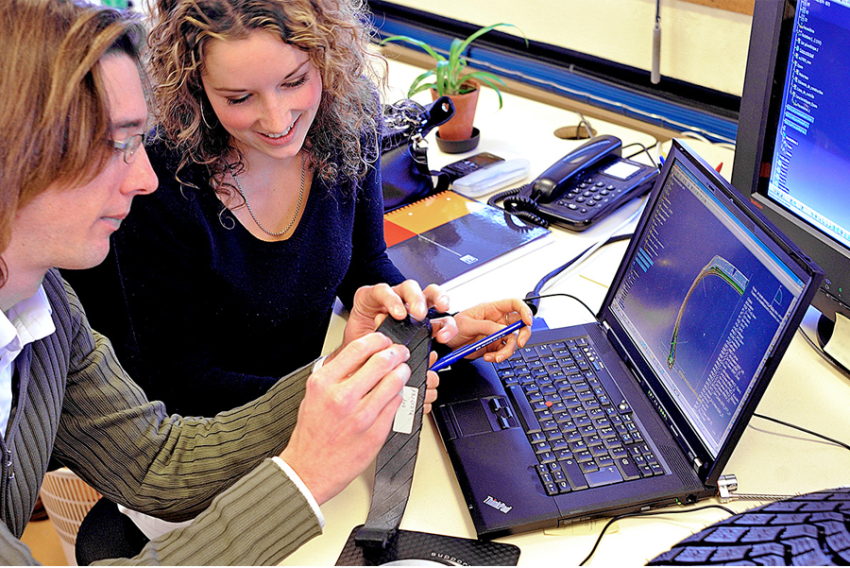
A Digital Twin, in a nutshell, is a dynamic digital replica of a tire, a machine, or production system that uses comprehensive data, analysis, simulations, and emulations to provide a wealth of information that can be used to virtually optimize the performance - of a product, machine, or production process - that is, by acting on the model and not on the physical object or process. Using virtual models, instead of costly and difficult physical experiments and assessments, it will be possible to design and test new tires faster and with less financial and environmental risks. Rockwell Automation mentions the example of a tire manufacturer using emulation implemented on a digital twin to virtually test the behaviour of compounds created with new ingredients. Another application is the move from designing, building and testing physical prototypes to a faster and more simplified approach using digital twins and simulation.
A look behind the scenes
It is reassuring to think that one can use a dynamic digital replica of a tire that simulates its behaviour, either on its own or mounted on a vehicle, during its life cycle and can also indicate the performance deterioration associated with aging. Digital Twins technology can also be advantageously used to devise and refine manufacturing operations, which has benefits for both equipment builders and tire manufacturers. However, all these advantages are not "free" but entail several, sophisticated activities, both upstream and downstream. In fact, it is necessary to prepare a mathematical computer model (e.g., with the finite element system) so as to have digital representations of the physical composition and geometry of a tire. Michelin, for example, collaborates with the institute of applied mathematics at Laval University in Quebec to prepare this model, while for the software it relies on contributions from Dassault Systèmes (which provides the Abaqus application), Siemens and others. The French manufacturer is keen to emphasize that it uses a wide variety of software because the range of its products - from tires weighing a few grams intended for bicycles to those weighing several tons for the mining industry - could not be covered by a single application; however, the "core" of the design tool is developed in-house.
This first model is then supported by one that describes its physical properties, such as heat transfer, pressures, vibrations, and sound emissions. Moving from product to production requires the preparation of models of manufacturing processes and automation, which, by digitally emulating tire manufacturing processes, allow them to be studied and improved. Digital technology aims to replicate the human experience with tires and their production, encompassing activities such as observation, handling, maintenance, operations, and personnel training procedures. Transversal to all these activities is then the analysis of data, which must be defined, collected and processed to move from raw data to information and, again, to decision making. These data are acquired from sensors to be sent digitally and concern the tire as well as the vehicle and production assets, which are increasingly being connected according to the precepts of Industry 4.0 and the Internet of Thing.
Digital better than real?
Digital Twins prove very useful in assessing the market opportunity for new tire models. Their use, for example, speeds up the development of high-performance tires, which are quite difficult to develop with traditional methods. Using artificial intelligence, for example, real-world data on raw materials can be combined with data resulting from advanced analytics, enabling researchers to accurately predict the properties of compounds before they are even produced and used. Another significant case involves a well-known tire manufacturer that used digital twin emulation to select, from among a variety of compounds made of different materials, the best one for a certain product. This made it possible to develop a special tire for hybrid vehicles that showed a 30 percent decrease in rolling resistance without compromising safety-relevant properties. Digital twins also improve the testing process, an essential pre-production step, with operational benefits. Streamlining the approach to designing, building and testing physical prototypes using a digital twin enables engineers to make the most of advanced simulations to reduce pre-production construction and testing costs by up to 25 percent, not to mention the savings in energy and raw materials made possible by reducing the number of physical prototypes needed. The experience of Pirelli, which uses an advanced simulator produced by VI-grade (the same supplier of Maserati and several other premium brands) goes in this direction. The simulator has a panoramic screen, spanning 210 degrees with 7.5 metres in diameter and reproducing different driving conditions, projecting scenarios such as roads and racetracks. In the centre is a model of a car equipped with various technologies that, through vibrations and movements of the seat, steering wheel, and seat belts as well as various shaking systems, accurately replicate the sensations of a moving car.
Cars “in a box”
Pirelli uses this equipment to "run" a virtual tire model, studying the forces that are created such as grip, rolling friction, how a tire behaves when taken to the limit, and other characteristics. However, since the behaviour of a tire varies depending on the car on which it is mounted, the car's Digital Twin is used in the simulator along with the tire’s digital twin. This is contained in a "box" with encrypted data to protect patent and for confidentiality reasons; data is exchanged using shared protocols. Pirelli admitted to having achieved a 30 percent reduction in the average development time of new tires, both for road and motorsport, due to faster evaluation of virtual prototypes produced for different car models. The flexibility of this procedure is such that joint design and development work can also be performed on the vehicle manufacturer's simulator, which makes it possible to develop the perfect tire and vehicle match at the same. Working on virtual tires also makes it possible to develop connected tire sensors that enable a transport fleet to achieve substantial improvements with tire issues.
Substantial benefits for the production stage
The phase of modelling, assessment and production processes, mentioned earlier, can equally improve through the use of digital twins. A tire manufacturer has seen its production go up by more than half a million tires a year by optimizing its production process through simulation. The results of adopting digital twins and machine learning have been significant, with an approximate 45 percent reduction in downtime and a substantial increase in production. From the perspective of tire equipment manufacturers, digital twins can also be a powerful business tool. Drawings and brochures can only go so far but being able to show how that machine will work in a potential customer's factory is a major leap forward. A 3-D model will be able to show a potential customer how a machine works in a virtual environment, but one can also think about using it with an augmented reality viewer that will allow a virtual interaction with the machine even before being physically installed. The digital twin also allows to put the machine in service virtually: before the physical unit is built, controls and processes can be tested on the digital model, which will behave just like the real machine. When the time comes to install the physical equipment, one will then have to deal with fewer unforeseen issues and less time lost in the start-up phase of the production process.