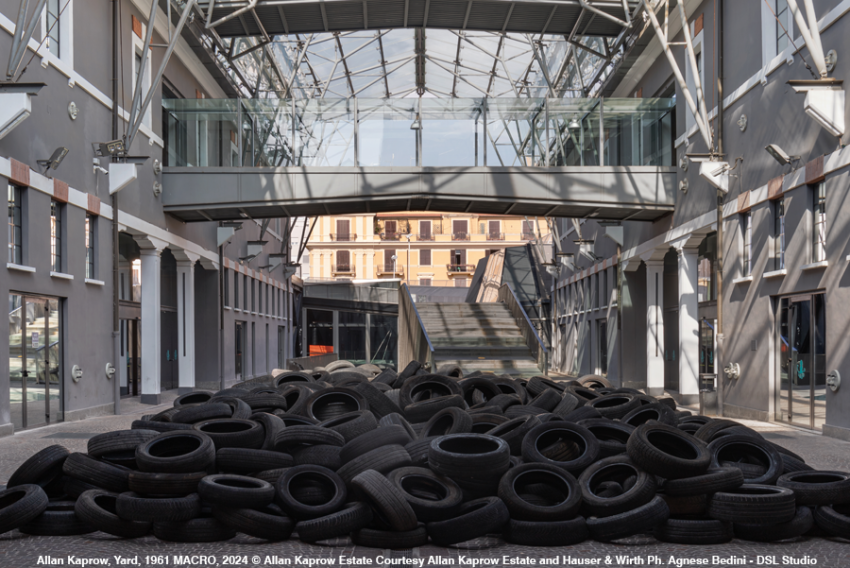
Elastic structures consisting of a flexible casing containing compressed air (tubeless tyres) or an inner tube also containing compressed air. If handling them is everyday business in the workshop, how would you react if you knew that tyres could also be found in museums? Allan Kaprow's Yard, installed in Rome on 5th September, is on show free of charge until 16th February in the courtyard at Macro – Contemporary Museum of Art in Rome. It was 1961 when, for the Environments, Situations, Spaces exhibition at the Martha Jackson Gallery in New York, artist Allan Kaprow randomly placed hundreds of used tyres in the gallery’s courtyard, from which five piles of tar paper emerged and covered sculptures within Martha Jackson's collection. Just as 63 years ago, visitors to the courtyard are encouraged to walk on the tyres, toss them around freely, helping to negate the idea that a work of art must necessarily aspire to a definitive state and satisfy a static-contemplative need. Allan Kaprow did not simply present a surface littered with tyres, but promoted an object to be acted upon, a performance event if you wish – and it is no coincidence since Kaprow himself was the first to theorise the happening art movement (from the verb to happen, an event, an art form expressed through images and taking place in a defined time and place) - in which the active participation of the public became essential, elevating them from simple spectators to co-authors of the work. Hundreds of used tyres. But when did such a familiar object enter the world of art and what was its meaning in each of these cases? It is a journey through the history of art guided, it must be said, by the tyre. Originally, it was Marcel Duchamp (1887-1968), faithful to the Dadaist vision, who denied art as a place of contemplation and ecstasy and questioned its expressive codes.
 The rejection of absolute aesthetic canons and questioning the aura of uniqueness of works of art found it’s perfect conclusion in the “readymade”: the anti-work-of-art par excellence. The artist chooses a ready-made object, preferably a banal, mass-produced one, takes it out of its usual context, places it in the world of art and bestows upon it an artistic value. It was in 1913 that a bicycle wheel, turned upside down and placed with the hub down, became a work of art: Duchamp challenged us to find aesthetic order in an anonymous and irrelevant object. A few years later, in 1919, the Berlin-based Dada artist Hannah Hoch (1889-1978) used the technique of photomontage to depict a cross-section of the cultural and political environment of Weimar Germany in her work Schnitt mit dem Küchenmesser Dada durch die letzte Weimarer Bierbier-Kultur epoche in Deutschland (cut with the Kitchen Knife Dada Through the Last Weimar
 Beer-Belly Cultural Epoch in Germany). The confrontation is entrusted to the collision of incongruous materials, so that the image of Kaiser Wilhelm II in imperial garment becomes a little more than a toy, since the large wheel at chest height could turn him like a child's toy. After a hiatus of some 30 years, random objects returned to the art scene with the advent of the New Dada movement, which took up the legacy of the oldest tradition of the historical avant-garde, Dadaism. In the 1950s, mass society began to churn out goods after goods, and art was ready to register the great development of a wide variety of products associated with the development and spread of heavy industry and its derivatives. Texan Robert Rauschenberg (1925-2008) incorporated this urban-commodity panorama of consumer goods, including tyres, into his works, at first tentatively, leaving only a trace of his passage, then more tangibly. To create Automobile Tire Print (1953), the artist covered a tyre with black ink and then printed it on paper, lightening an otherwise heavy and cumbersome object, with the pleasing pattern created by the wheel.
 This gesture was the result of a mechanical action chosen by the artist as a symbol of the advancing world of commodities. At the same time, Robert Rauschenberg began to collect objects from the streets, rubbish dumps and all sorts of shops and then to assemble them, creating the Combines series, works that, as the name suggests, combined paintings, sculptures and objects of all kinds, with the aim of reducing the distance between everyday life and art. Among the most famous Combines is Monogram (1955-59), which, in its third and final version, consisted of a stuffed angora goat with its midsection passing through a car tyre and resting on a canvas on the floor. Rauschenberg redeemed the tyre: on the one hand, he elevated it to the status of a work of art; on the other, he exploited the surprise effect of the presence of an object that was familiar but, at least until then, completely alien to the artistic context.
 Leading figures of American Pop Art, influenced by the New Dada experience, placed the anti-art object par excellence at the centre of their work, the consumer object, mass-produced, created by industry and advertised by the mass media. And, like Rauschenberg, they sought to redeem it through techniques of alienation that gave consumer goods a new aesthetic dignity, elevating them to the status of cult objects. This is what happens in the work Tire (1962) by Roy Lichtenstein (1923-1997). In this case, the artist chose to enlarge a product of contemporary civilisation, the tyre, assigning to it the emblematic status of an icon. Integrating an everyday object into an artistic context was the response of Pop artists to the need to re-establish a proximity between the artistic process and the everyday reality of consumerism and advertising.