The wide range of time periods in which classic cars were built and their technical specifications make the world of historic car racing very diverse: cars from different periods and with different power classes may find themselves racing together. For this reason, in order to level the playing field, cars that physically take part in the same race may compete for different rankings or score points with different coefficients, as specified in the sporting regulations of the individual championships. In the world of racing, the main disciplines are divided into rallies, circuit racing, and hill climbs.
Rallies
Rallies are sporting events that take place along routes divided into sectors (stages), each of which normally includes regularity stages on roads open to traffic, where compliance with the rules of the Highway Code is mandatory, and special stages at free speed on sections closed to traffic. The crews (consisting of a driver and navigator) start one at a time, spaced out by a time margin that prevents the cars from meeting along the route. Once all the special stages that make up the rally have been completed, the crew with the lowest time in the cumulative ranking of the individual stages is declared the winner. In historic rallies, cars must be presented at pre-race checks with tires bearing the road approval stamp (E mark) and without any other restrictions on use. In Italian Championship races, tires must be equipped with an identification barcode. The markings and barcode must be highlighted in yellow so that they are visible and recognizable throughout the rally.
Rally championships are run with road-derived cars, i.e., versions that have been upgraded and prepared to compete on different terrains, mainly asphalt and dirt roads (which can be earth or gravel), which require particular attention when choosing tires. The main manufacturers of tires for asphalt rallies are Pirelli, Michelin, Hankook, and Avon. Pirelli offers a specific range, the P7 CORSA CLASSIC, in four compounds: D3 hard compound, recommended for temperatures above 25°C; D5 medium compound, for temperatures between 10 and 30°C; D7 soft compound, for temperatures between 0 and 15°C; and finally, W7 for wet conditions. All three dry compounds feature the P7 CORSA tread pattern, while the wet compound has the P7 CORSA WET pattern. The Pirelli range covers 13 to 17 inches. Michelin offers a dedicated range for dry asphalt rallies, the TB5 (with a single compound), and one with a rain compound, the TB15. Hankook and Avon offer a range with only dry compounds for rallies. For dirt road routes, it is possible to use Pirelli and Michelin modern competition products (the SCORPION AT and SPORT GRAVEL lines, respectively) adapted to classic sizes.
Circuit speed
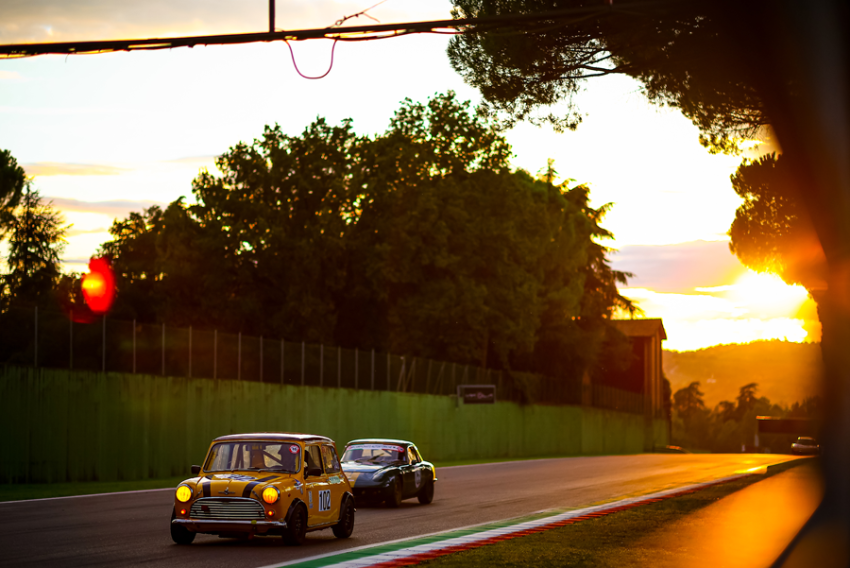
The speed sector consists of speed races that take place on the track. In track races, cars line up at the starting line according to the order established in qualifying. Unlike rallies, all cars start together, and the first to cross the finish line at the end of the allotted time (or number of laps) wins.
For this type of competition, it is appropriate to consider the classification scheme developed and disseminated by the FIA (International Automobile Federation), which defines the classification periods for cars, as a watershed. For cars prior to the G1 homologation period (up to December 31, 1969) participating in circuit speed races, Dunlop Racing tires or road-approved tires (e.g., Pirelli CN36, Michelin XASFF, and Avon CR6 ZZ) are recommended. For cars after this homologation period, we recommend modern slick tires offered by Pirelli, Michelin, and Hankook, adapted to sizes compatible with classic cars, and modern style treaded tires for rain. When choosing tires, it is important to remember that the regulations for these competitions set a limit on the height of the tire shoulder below which it is impossible to compete.
Hill climb speed
Hill climb races, also known as time trials, see different categories of cars compete on an uphill course. They are run on roads closed to traffic, with the aim of climbing as quickly as possible from point A to point B. The cars race one at a time on the stretch of road and the final comparison is made on the stopwatch. The same criteria outlined for circuit racing can be applied when choosing tires.