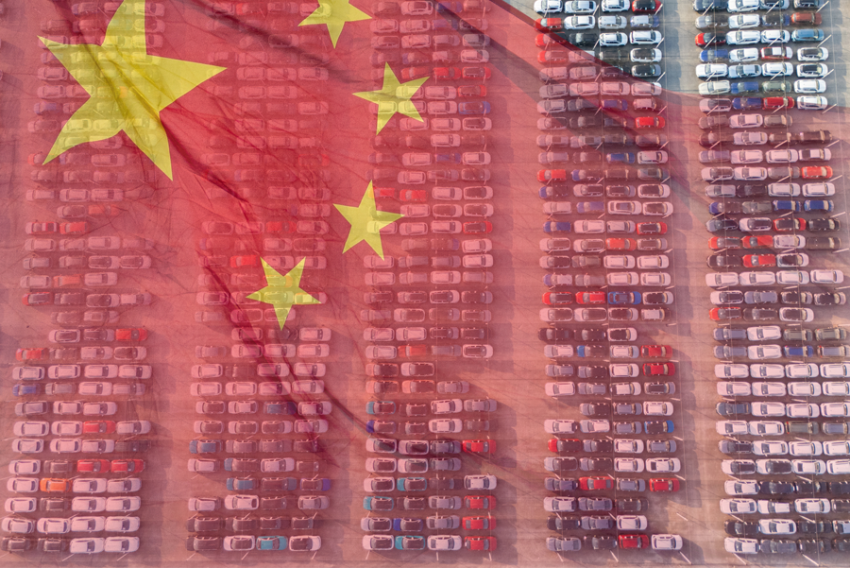
This new phase in the Chinese automotive industry no longer relies solely on ports, aggressive pricing, and ships loaded with cars arriving in Europe from Shanghai or Shenzhen. It now involves European assembly lines, industrial areas left half-empty by established manufacturers, and agreements with groups that, until just a few years ago, would have viewed Beijing merely as a distant competitor. According to AlixPartners, Chinese automakers aim to increase production capacity outside China from 1.2 million vehicles to 3.4 million by 2030.
Circumventing Tariffs
This push stems from three factors. The first is domestic overcapacity, fueled by years of investment, incentives, and intense internal competition. The second is the price war in China, which is squeezing margins just when capital is needed for brands, sales networks, software, and batteries. The third is the protectionist response from export markets. In Europe, tariffs on electric vehicles manufactured in China are added to the standard 10 percent rate and, in the most severe cases, reach levels that make local assembly more cost-effective.
The Geely Case at Ford’s Plants
The most emblematic case is that of Geely in Spain. The Chinese group, already the owner of Volvo and a major shareholder in many European operations, has been identified by the trade press as the buyer of a portion of Ford’s plants in Valencia. The idea would be to use production capacity no longer fully utilized by Ford’s programs to assemble Geely models destined for the European market, likely based on the Gea architecture. For the Almussafes plant—which covers an area of over 300,000 square meters and is capable of producing approximately 2,000 vehicles per day—this would be a response to Ford’s declining production volumes. For Geely, it would mark a direct entry into manufacturing in a country with a mature automotive supply chain, suppliers, and logistics infrastructure.
Leapmotor and Dongfeng at Stellantis Plants
Leapmotor is pursuing a different, more integrated path with a European automaker through its joint venture with Stellantis. After the launch and subsequent halt of assembly of the small T03 in Tychy, Poland, the focus has shifted to Spain. Stellantis and Leapmotor have announced plans to bring production of the B10 compact SUV to the Figueruelas plant, near Zaragoza, by 2026. The same model applies to Dongfeng. Stellantis and the Chinese state-owned group have signed a proposal for a European joint venture with shared operations in sales, distribution, production, procurement, and engineering. Voyah-branded models will be produced at the plant in Rennes, France. For now, Italian plants remain out of the picture, as their current production levels fall short of their true potential.
BYD in Europe
BYD, on the other hand, has opted for direct investment. The plant in Szeged, Hungary, is expected to begin assembly in the fourth quarter of 2026, with the Dolphin Surf among the first models. The timeline has been pushed back from initial ambitions, but the direction remains the same. BYD wants to manufacture in Europe and, according to statements from its top executives, is also looking at a second factory.
Chery at the Nissan Plants
Chery represents another piece of this same transformation. In Barcelona, at the former Nissan site, the partnership with Ebro aims to build up to 150,000 vehicles per year by 2029, with the Omoda 5 and Jaecoo 7 among the planned models. In the United Kingdom, Nissan has signed a non-binding agreement to evaluate the production of Chery models in Sunderland starting in 2027.
Good or bad for Europe?
The arrival of Chinese car production in Europe can be interpreted in different ways. On the one hand, it might seem like part of a full-scale invasion of the Old Continent; on the other, it would create thousands of jobs and potentially utilize the European parts supply chain.

Chinese Cars Arrive at European Production Plants, Bypassing Tariffs and Logistics