Caster angle
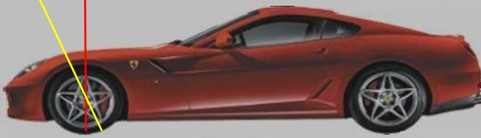
The projections of the steering axis—which connects the two fixed suspension mounting points—define the caster angle and kingpin tilt on the vehicle’s longitudinal 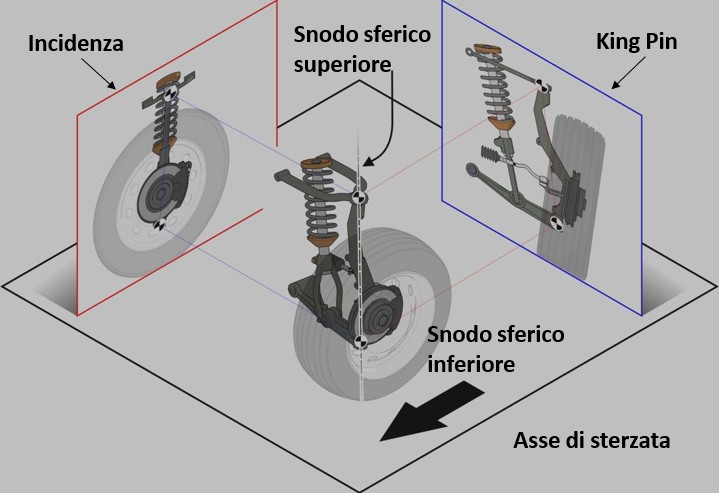 and transverse planes, respectively. Caster is measured by turning the steering wheel 10° or 20°. In the event of significant asymmetries in the caster values between the two wheels, the vehicle may exhibit a tendency to drift toward the wheel with the lower caster value. Positive camber is defined as when the upper joint of the steering axis is angled backward. Negative camber is defined as when the upper joint of the steering axis is angled forward.
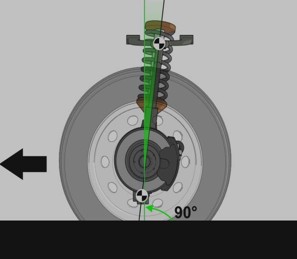 Proper camber ensures directional stability and steering wheel return to the straight-ahead position. In fact, simply turning the wheels of any production car fully from the initial position—with the wheels straight and perfectly (or nearly) perpendicular to the ground—to a turned position is enough to notice that, when turning left, the right wheel has negative camber and the outer wheel has positive camber. When cornering, the weight distribution changes, radically affecting the camber value. With positive caster, the kingpin lowers when steering outward and rises when steering inward. After the turn, when the steering wheel is released, the vehicle’s weight returns the steering to a straight-ahead position, so that the load is evenly distributed on both sides. In this way, positive caster ensures that the steering wheel returns to center. It is important to remember that the caster angle affects steering effort; the greater the positive value, the greater the steering effort will be. For this very reason, manufacturers’ databases may list more than one value for the caster angle. Vehicles with mechanical steering have the lowest value.
King pin inclination angle
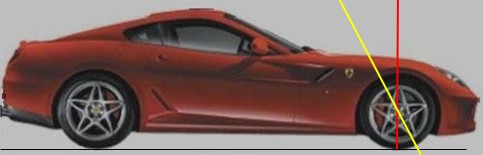
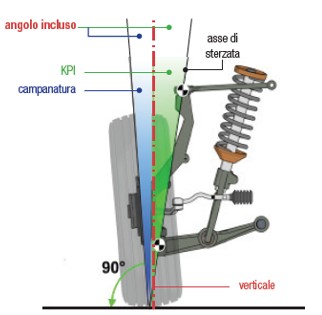 The king pin inclination angle, also known as KPI (King Pin Inclination) or SAI (Steering Axis Inclination), is the angle formed between the vertical and the projection of the steering axis onto the vehicle’s transverse plane. It is measured during a 10° or 20° steering turn. The angle obtained by adding the kingpin inclination angle and the caster angle is called the included angle.
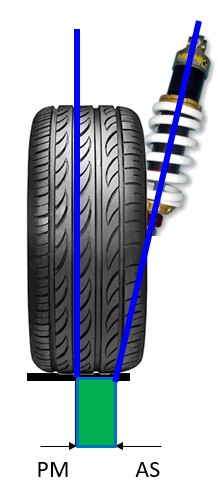 Knowing this value is useful during maintenance because, if the included angle is correct even when the caster or pillar inclination values are incorrect, the problem may be due to deformation of the suspension arms or the mounting points on the body. The ground arm, generated by the cast kingpin inclination, is the distance between the wheel’s median plane (PM) and the steering axis (AS), measured at ground level. This parameter directly affects the effort required to turn the steering wheel, the wheels’ automatic return to a straight-line position, and—if the values differ between the two sides—can cause lateral drift during acceleration and braking. Correctly evaluating the ground arm is essential, as variations in this parameter significantly alter the vehicle’s dynamic behavior.
Negative ground arm
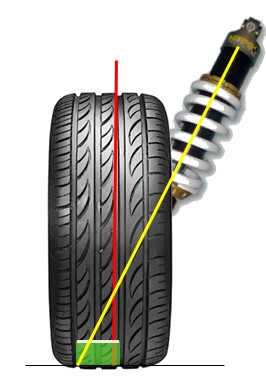
This configuration offers the best results in terms of stability and steering response, especially if the negative value is modest. It ensures greater driving safety and improves the vehicle’s ability to maintain its trajectory.
At low speeds, it can result in increased steering effort, which is offset by the power steering system.
Positive caster
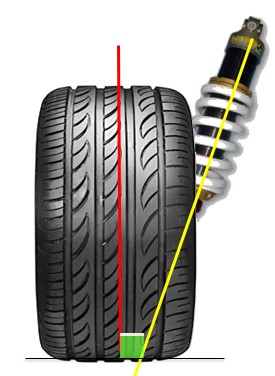
It provides a greater sense of stability when driving in a straight line, but when cornering, it tends to spontaneously return the wheels to a straight-ahead position. The driver must therefore apply more force to the steering wheel to maintain the intended path.
Zero caster
This is not an ideal solution, as it makes the steering extremely sensitive to external forces—particularly road surface irregularities—requiring constant course corrections. A negative caster geometry also helps compensate for any differences in traction between the two steering wheels on the same axle. Under these conditions, the wheel with greater traction tends to steer inward, helping to offset the loss of traction on the other wheel and thus improving directional stability, even on rough, wet surfaces or in the event of hydroplaning.
In the event of vehicle modifications or conversions, it is essential to always adhere to the specified offset (ET) values for the rims, as incorrect adjustments can alter the trail and compromise dynamic behavior, steering precision, and safety.
Steering angle
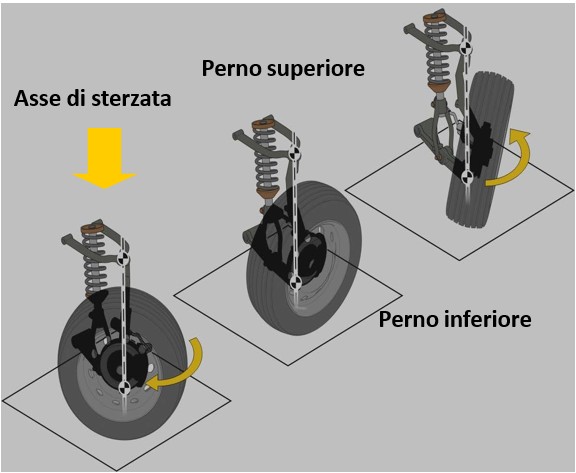 When the inner wheel steers by 20°, a difference in toe-in occurs between the inner and outer wheels. If both wheels turned at the same angle, they would follow different radii of curvature, causing the tires to slide sideways.
To ensure proper wheel roll when cornering, it is therefore necessary for the two front wheels to have different steering angles. The difference between these angles is known as the Ackermann angle. A large steering angle difference between the two wheels improves precision in very tight turns but causes the vehicle to take a wider line, increasing understeer. Conversely, a small steering angle difference makes the front axle less precise when entering a turn but helps reduce the vehicle’s understeer.