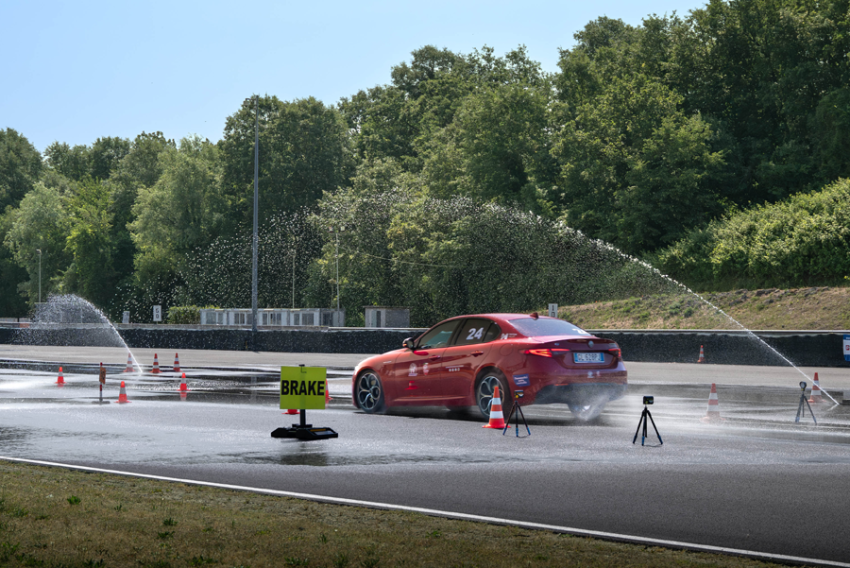
A tire’s manufacturing date does not affect its performance. Assogomma set the record straight once and for all on this issue during the “Tires Under Scrutiny” initiative with track tests. For some time, fake news had been circulating online claiming that tires with a more recent production date offered better performance and greater safety than new tires with an older production date. After all, “fake news” spreads faster than the truth. This was demonstrated a few years ago by a study conducted by MIT and published in the journal *Science*. According to the analysis, false stories take 19 hours to reach 1,500 users, while true ones take 60 hours. It was precisely to debunk these false claims about tires that Assogomma, together with instructors from the De Adamich racing team, conducted dynamic track tests.
Performance tests were conducted at the Varano de’ Melegari circuit, which was transformed into an open-air laboratory for the occasion. The goal of the tests was, on the one hand, to demonstrate that tread depth and tire pressure affect safety, fuel consumption, and environmental impact, and, on the other hand, to verify the relationship between the date of manufacture and performance. “With these tests, we wanted to clarify that the age of the tire—that is, the date of manufacture—does not affect the tire’s performance characteristics,” said Fabio Bertolotti, general manager of Assogomma. “We conducted tests with different vehicles, equipped with tires from different brands. The only difference was the date of manufacture: in one case, the tires were recent, and in others, we could say they were older—but only 2–3 years old. The braking performance on both dry and wet surfaces was absolutely identical.” The date marked on the tire is information that the manufacturer uses to trace the production week of that specific tire, in case defects are discovered later on. “To maintain the tire’s initial performance characteristics over time, the retailer, wholesaler, distributor, and end consumer must store it according to ETRTO recommendations,” Bertolotti clarified.
Track Tests
The test day began with tests on dry pavement. The vehicles, equipped with tires of the same size but with different production dates, were driven at speeds between 70 and 90 km/h. Thanks to on-board data acquisition systems, the stopping distance was calculated consistently and averaged across multiple runs, demonstrating that, given identical specifications and proper storage, performance remained essentially the same. The comparison then continued with braking tests on wet pavement at 50 and 70 km/h, using a similar procedure. In this case as well, the goal was to provide objective evidence that the age of the tires had no effect. In both tests, the differences were only a few centimeters, with results sometimes favoring the newer tires and sometimes the older ones. Also on a wet surface, a mid-speed cornering test (70–80 km/h) was then conducted.
In this case, the intention was to understand the difference in handling between a car with new tread on the front axle and worn tread on the rear, and vice versa. The result was that the cars with rear tires in better condition passed the test, while the one with worn rear tires exhibited oversteer issues to the point of losing traction. “Tires with greater tread depth must always be mounted on the rear axle, regardless of whether the vehicle is front-wheel drive, rear-wheel drive, or 4x4,” Bertolotti clarified. “We can control a vehicle’s trajectory with the steering and thus influence the front end, but if we lose traction at the rear, we’ll lose control of the vehicle. So the best tires should always be mounted on the rear axle.” A final test focused on tire pressure, which, if insufficient, affects handling and driving precision, tire wear, and fuel consumption. “The correct pressure optimizes fuel consumption,” Bertolotti emphasized. For the same distance and driving style, a car with underinflated tires (-0.5 bar) increases fuel consumption by 12% to 15%. Proper tire pressure offers economic benefits and a lower environmental impact, along with significant road safety advantages. So it’s always a good idea to visit a tire shop to have them checked.”

Assogomma: Track Tests to Debunk Fake News About Tires