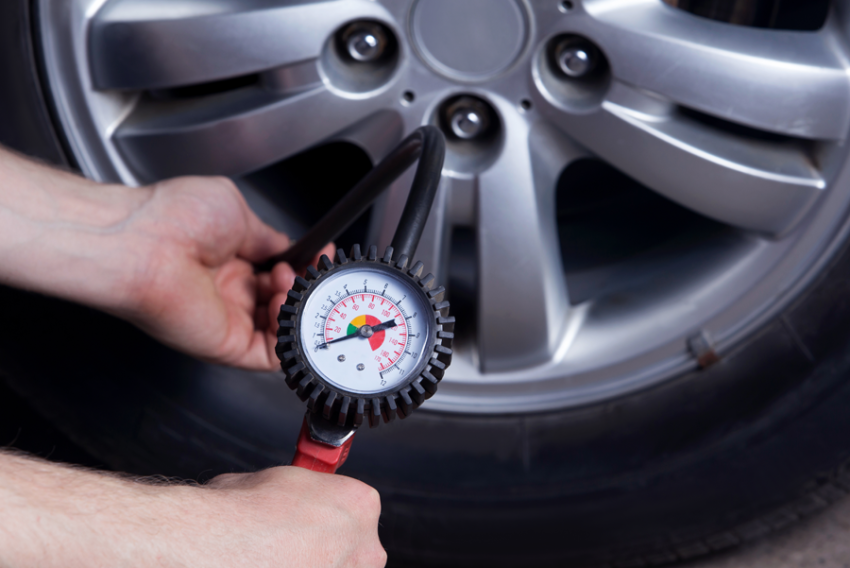
Inflating tires and powering pneumatic screwdrivers are the two main functions required in a tire shop. Not the only ones, mind you, but they are enough to understand the important role played by compressed air and the equipment used to produce it: compressors. There is always more than one in a workshop, and not only because one might need a backup tool when the main one is under repair for some reason.
To each his own
Whereas at one time, with small workshops and work being done partly on the street, the role of movable air compressors was essential, today's tire shops always have a large compressor feeding the workshop. Attached to this are tire inflators, portable tanks, screwdrivers and other pneumatic tools, and lifts, used both for work on tires as well as other activities in the automotive aftermarket. Understanding the number of tools connected and their frequency of use is critical to choosing the right-sized compressor, while other needs guide the choice of equipment type: containment of noise emissions, working with other gases such as nitrogen, and limiting energy consumption and initial investments. Tire dealers mainly use reciprocating and rotary screw compressors; the former being suitable for smaller units to be used directly with pneumatic tools or to supply small networks and is favoured with movable compressors or small stationary compressors, often without anti-noise systems, while the latter is mainly used for stationary installations contained in soundproof cabinets. Reciprocating compressors can be powered by 220 V (the usual voltage for portables) or 380, which is more common for stationary installations, whereas screw compressors generally require 380 V. The technologies described by no means represent the entire compressor landscape, so much so that at least two other technical solutions coexist in the automotive sector as well: screw and rotary vane compressors. Compression technology is not the only factor driving the choice: air requirements must be accurately assessed to avoid buying an undersized compressor (leading to high energy consumption and premature wear) or conversely an oversized one (high purchase cost, failure to reach operating temperature resulting in condensation droplets and, consequently, corrosion of metals, contamination of lubricating oil and premature wear of moving parts). Finally, a very topical issue is consumption: even before the current surge in energy prices, the power consumed by a compressor in its life cycle cost more than ten times its purchase price. Currently the market features international brands side by side with long-standing national brands, both of which cut across various sectors of the industry. In these pages, a concise review of what can be found in the Italian market today.
Elgi
 The Italian subsidiary of the Indian multinational (one of seven national branches managed by Belgium's Elgi Europe) was born from the acquisition of a historic Italian brand, Rotair of Caraglio (CN). It currently manufactures in India, Italy and the United States and specializes in both lubricated and oil-free screw compressors. The oil-free range has two series: OF with powers ranging from 45 to 450 kW and air production from 5.4 to 73.7 m3/min, and the latest AB with powers from 11 to 110 kW and capable of producing from 3 to 13.7 m3/min, designed to keep operating costs down and suitable for applications that require particularly clean air, such as painting. Elgi introduced oil-free technology to the automotive sector and works with a single compression stage; cooling the screw unit is done by distilled water which is then recycled with a reverse osmosis cycle. The small inlet and outlet air temperature difference of 8°C ensures long dryer life. For irregular use, typical of small-medium-sized tire shops, EN series lubricated screw compressors offer power ratings from 3 to 37 kW; like other Elgi units, they are built with components designed and manufactured in-house and thanks to treatment systems they deliver perfectly dry air. They are also suitable for workshops without a compressor room as they are quiet enough. Recently the company also introduced the simple and compact TS series to our market, consisting of four models: 2.2, 3.7, 5.6 and 7.5 kW, two-stage with two-cylinder compressors equipped with cast iron heads and forced cooling. These are ideal as backups during particularly high demands and workloads.
Fiac
 The Bologna-based company offers an extensive catalogue of reciprocating and rotary compressors. The first can be both mobile and stationary, with or without a tank, with belt drive or direct coaxial drive, and are also available soundproof. Screw models are available with gear drive or direct with inverter control. Among these, the latest is the Light Silver series, which integrates the advantages of piston compressors (compact and easy to install) on a screw unit, reliable, powerful, and cheaper to operate. Particularly suitable for smaller industrial applications with high compressed air requirements, such as tire shops that require constant pressure with no surges. Energy consumption as well as air contamination with lubricating oil is greatly limited (less than 6 ppm versus the 30 normally found with a piston unit) and has maintenance-free main components. Noise emissions are as much as 20 dB (A) lower than a piston unit, making them suitable for installation close to the working area. The series consists of four models available with 8 or 10 bar operating pressure: LS4 (4.44 or 3.52 m3/min), LS6 (5.64 or 6.98 m3/min), LS8 (7.80 or 7.26 m3/min), and LS10 (8.52 or 8.40 m3/min). Each model can be combined with 90+90-liter cylindrical tanks arranged in parallel or single 200- or 270-litre tanks, mounted under the compressor box, and the dryer unit alongside it.
Gis
 Based in Carpi (Modena), this manufacturer specializes in all types of compressors used in the automotive supply chain: reciprocating, rotary, lubricated, oil-free, stationary, wheeled, with soundproof cabinet, tank-mounted, with coaxial or belt drive, single- and two-stage, tandem (i.e., two motor-compressor units). The extensive catalogue also includes air treatment systems and various accessories. The tandem compressors range, one of the company's specialties, are based on the 500 and 1000 series (the numbers indicate the tank capacity in litres), the former consisting of six models and the latter of four. The 500 series draws 1,000 to 1,700 litres of air per hour using two belt-driven, twin-cylinder compressors driven by motors ranging from 3 to 5.5 kW; noise emissions range from 77 to 79 dB. All are mounted on stands and have a timed starting unit; compression is two-stage except for the entry level model. We find the same features on the 1000 series, which draws from 1.7 to 2.365 m3/min and uses two twin-cylinder compressors with 5.5- or 7.5-kW motors for the first three models, which emit 79 dB (A); the top of the range, which draws 3.2 m3/min, has two four-cylinder compressors with 11 kW motors; noise emission is 80 dB (A).
Another special feature of the Gis catalogue are compressors with vertical tanks (an ideal solution for small spaces), mounted on stands or wheeled. These are belt driven and can be single-stage or two-stage. The range includes the 24, 50, 100 and 270 series (again, the number indicates the tank capacity in litres), all of which can be purchased with stands, trolley or brackets for mounting the unit on a wall. The only model in the 24 series draws 2.5 m3/min and has a 1.5 kW motor coupled with a single-stage twin-cylinder compressor, with noise levels of 73 dB (A); the three models in the 50 series, all single-stage twin-cylinder, are two 2.5 and one 4.5 m3/min, with 1.5- and 2.2-kW motors, respectively, while noise levels range from 72 to 78 dB (A). The 10 single-stage models in the 100 series, all with twin-cylinder compressors, provide air intake of 250, 330, or 500 m3/min thanks to motors ranging from 1.5 to 3 kW with noise emissions of 72 to 78 dB (A); the series is completed by two dual-stage models with 4 kW motors and noise levels of 78 dB (A). The six models in the 270 series are all dual stage except for the entry level, offering motors from 3 to 7.5 kW and air intake from 5 to 1,182 m3/min. Noise emissions range from 76 to 78 dB (A).
Ies
 Not to be outdone, this Verona-based manufacturer also offers a wide range of compressors for automotive applications, from reciprocating or screw compressors with direct or belt drive to fixed screw compressors with soundproofing mounted on the tank or based on a large cabinet containing every component. Particularly interesting are the top of the range soundproof iCD series, with permanent magnet electric motor and direct drive; this solution, as there are no intermediate parts between motor and compressor, increases reliability and reduces operating and maintenance costs, while allowing continuous speed variation from 20 to 100 percent of compressor capacity. The series consists of 26 models with abbreviations from iCD 7.5 to iCD 200 (the number indicates power in kW), single or two-stage with motors from 7.5 to 200 kW, operating pressure of 8 or 10 bar, and air intake from 7.75 to 34.5 m3/min. The smallest have a soundproof cabinet mounted above the tank; the others house all the components in one box. Noise is particularly low: 64 to 74 db (A) depending on the model. From 3 to 22 kW, on the other hand, is the power output of the SCB and ECB series, with belt drive and similar structure to iCDs; ECBs have variable speed drive. There are 12 SCB models on offer, with intake from 0.36 to 3.20 m3/min, motors from 3 to 22 kW, and 10 ECB models with intake from 0.24 to 3 m3/min, motors from 7.5 to 22 kW, and pressure ranging between 8 and 10 bar. Noise is contained between 63 and 70 dB (A) for SCBs and 67 to 70 dB (A) for ECBs. The latest innovation from Ies is the Multi-Gen 1, a unit capable of generating compressed air at 8 or 10 bar and nitrogen also at 8 or 10 bar with adjustable purity grade; it has a 270-litre air tank and a 200- or 270-litre nitrogen tank and can use an oil-free compressor.
Mattei
 From this more than 100-year-old Italian compressed air maker, based just outside Milan, comes the RVXi stationary units, from 55 to 90 kW, mounted in soundproof cabinets and based on a vane compressor. This technology, coupled with inverter drive, provides considerable energy savings if the compressor is used most of the time with demand ranging from 40 to 70 percent of its rated capacity, a common situation in garages. The cast iron cone vanes are guaranteed for life, and the rotor/stator unit has no bearings, so that over 100 thousand hours of operation are guaranteed before the pumping unit needs an overhaul. Cooling comes thanks to a servo-assisted thermostat and a variable-speed fan controlled by the Maestro XC electronic control system, and the generous size of the coolers. The range consists of three models RVXi 55, 75 and 90, offering operating pressures from 7 to 10 or 7 to 13 bar, air intake from 5.22 to 12.67 m3/min and motors ranging from 55 to 75 or 90 kW. RVXi units are also available in Plus versions with a refrigerated air dryer and condensation separator with automatic drain, which are also available as optional on regular models. The iR versions, on the other hand, have an energy recovery system that converts about 80 percent of the mechanical energy into hot water (used for the air process). An optional six-year extended warranty is available for all.